Erecting a Covenant
“I will erect my covenant between me and between you and between your seed who come after you through their generations as an everlasting covenant—to be God to you and to your seed after you.”
(Genesis 17:7)
Even the language that God uses here denotes the permanent nature of this covenant. He says, “I will erect…” The verb that he uses here denotes the idea of building a castle tower, something strong and permanent that stands for all people to see. In addition, the Hiphil form of this verb is used, which reflects that God is causing something to take place—God is the one erecting this covenant, Abraham has no part in its building (and as we saw in chapter 15, no part in its completion). In addition, the eternal nature of God’s unchangeable purpose (Hebrews 6:17-18) and character (Malachi 3:6) provide this everlasting covenant its absolute permanence. Because God is, this covenant stands even today despite the wickedness of the heart of man. Friends, that is something to rejoice about.
Notice too, the language about the seed of Abraham. This is a reference to his children and to his children’s children throughout the generations. Some would try and suggest that this language of seed only applies to Jesus, as Paul says that the Seed is Christ (Galatians 3:16). Yet, while the covenant is clearly fulfilled in and by Christ, to see Christ as the only end of this promise is to take the language out of context. God is clearly promising this covenant not only to Abraham, but to his covenant household—hence the sign of the covenant that will be given a little later in this chapter will be placed not only on Abraham and not only on those in Abraham’s household old enough to accept the covenant on their own, but also on their children and infants. Thus, in the New Testament age, we place the covenant sign of baptism on the children of believing parents to indicate that they are part of the blessings of this covenant because of their parents.
Loved ones, cherish God’s covenantal promises to you—he will be God to you and will never abandon you. This promise is more valuable than anything else on the whole of the earth. It is permanent and established in stone and God will never fail to bring it about in your lives. In addition, the covenant is not just about you, but it is about your children and your children’s children after you. Rejoice in that and raise your children up knowing these great promises of God that one day they too may accept them as their own. Sing of the might of our God, for these promises do not rest on the work of men, but upon the character and plan of God. He has established them in stone, confirmed them in blood, and will renew them in your life—day in and day out.
Come, let us use the grace divine, and all with one accord,
In a perpetual covenant join ourselves to Christ the Lord;
Give up ourselves, through Jesus’ power, His Name to glorify;
And promise, in this sacred hour, for God to live and die.
-Charles Wesley
The Conversation
“Some weather we’ve been having, isn’t it?” “Did you see the game last night?” “Did you read the paper this morning, with crime going up and unemployment going up, what is this world coming to?” “Did you hear what those democrats did?”
Conversations, we all have them every day and usually they are had around some fairly mundane subjects—weather, sports, news, politics, etc. Most of the time, we strike up these conversations without much thought and they are over almost as quickly as they begin. Most of the time these conversations are had with complete strangers with no expectation of ever seeing them again. So, of what value are they? Do they serve a purpose other than that of trying not to look unsociable and filling up dead air with useless chatter? I am not convinced that they do.
But what if even those short conversations were ones that could become significant? What if they could become eternally significant? Would we have the conversation if it contained meaning and not just noise? What if we opened our conversations with, “where do you go to church?” instead of “what do your think of the weather?
God has given us language so that we can exchange ideas with one another in community—that is what the very word, “conversation,” means—“to exchange ideas.” In addition, ideas have consequences because the ideas you offer will in turn spark ideas in the mind and hearts of those who hear them. The question is whether or not you are exchanging ideas of consequence or whether you are merely beating the air. The weightier the idea the more significant the consequence.
One of the things that concerns me, though, is that as a society we have become rather superficial not only in our conversations but in our ideas. It is almost as if we are afraid of the consequences of significant conversation so we opt to avoid it altogether. Yet significant conversations are essential for building significant relationships and significant relationships are essential for effecting change in peoples’ lives.
So, what do your conversations look like? Are they significant or do you play it safe, seeking to stay in the shallow end of the relationship pool. If we are going to effect change in our community, shallow will not cut it. We need to enter into the deepest end of the pool and speak of the resurrection of the very Son of God who came into this world, lived amongst men, died a horrible death to atone for the sins of his people, and rose again on the third day. There is no conversation more significant that that and there is no conversation that this world needs to hear more than that one. Will you be the one to have that conversation with those you meet, though?
The Law of the Jungle
Recently, I read of the following account:
Elephants and rhinos normally get along quite peacefully, though the elephant defends her calf against any hint of aggression. Once a baby elephant at a water hole near Tree Tops Lodge, in Kenya’s Abedare National Park, playfully approached a rhino. The rhino charged, sending the calf squealing back to its mother, and then the rhino sauntered off. The mother elephant was so enraged that she turned and attacked another rhino drinking nearby, sending a tusk into its chest. While tourists watched from the lodge’s terrace, the elephant then held the innocent rhino underwater with her forefeet until it drowned.[1]
The Law of the Jungle is brutal. It is a law that essentially says, you can do whatever you can get away with. It is a law that says that you, the individual, and perhaps (but not always) your family is the only thing that is important. It is a law that permits one not only to hate his enemy, but also to turn on his friend if such is expedient. Power and survival are the sole virtues of the Law of the Jungle and one’s purpose in life is simply the gaining and preservation of power and the propagation of one’s own line. Sacrifice is meaningless unless it brings about that end. The strong survive; all others are merely in the way.
What struck me about this little account of the elephant and the rhinoceros was not only the brutality of the event where the mother enacts her revenge on an uninvolved bystander, but sadly, how often Christians act in much the same way when dealing with one another. True, we typically don’t drown people in watering holes, but how often we drown others with criticism, exclusion, or outright hostility. How often we follow the example of the Jungle and not the example of Christ in our personal dealings.
In the jungle, when one is offended, revenge is the response. There is no such thing as humility or grace, these things belong only to those who bear God’s image. And in the jungle, when revenge is handed out, there is always an escalation of aggression—even a minor offense yielding capital punishment as in this case. There, of course, are many who would point to the brutality of many of the Old Testament Biblical laws, but the concept of “an eye for an eye and a tooth for a tooth” is a principle that states that the punishment must suit the crime. One could not demand execution in response to a personal injury—in the jungle, as the account of the elephant and the rhino illustrates, death is common even for small crimes. It is not a matter of justice, but of severe vengeance served cold and bloody.
It should not be too surprising when non-Christians choose to follow the Law of the Jungle for philosophically they simply see humanity as a highly developed animal living under the same rule as our “cousins” in the animal kingdom. In addition, to really give grace to others, it requires that one have experienced it in a transforming way. And free grace is one of those things that really is unique to Christianity and to the way our God deals with us.
What grieves me is when I see professing Christians choosing to follow the Law of the Jungle instead of another law—the law modeled to us by Christ—is that they demonstrate that they don’t really understand what it is that Christ did on the cross. When Jesus hung upon the cross of Calvary, the man without sin, being judged as a sinner, his words were not that of vengeance, but he said, “Father, forgive them, for they do not know what they are doing.” The word we translate as “forgive” is the Greek word ajfi/hmi (aphiami), which means to pardon, forgive, or to release from legal obligation.
We owe a debt to God because we have broken his law. In addition, we owe a debt to God because we have inherited the unpaid debt of our fathers that have gone before us (Exodus 20:5, 34:7). This debt goes back to Adam (1 Corinthians 15:20-22). God is righteous and righteous justice is demanded for sin—we have inherited death and earned wrath. Yet, God chose to do something unheard of; he took the punishment for a group of people upon himself by sending his Son, Jesus Christ to die and bear his wrath in their place—a substitutionary work of atonement. To Christ’s work, we contribute nothing. Jesus has fulfilled the righteous demands of the law on our behalf and we vicariously benefit.
Who is the “we” that benefit? It is those who have been given new life by the Holy Spirit (John 3:3) and are thus drawn to Christ in faith. This is a work totally dependent on God and on his Grace, not upon who we are or what we might be capable of doing. Were it earned in any way or reliant on our works in any way, Grace would no longer be Grace (Romans 11:6). In theological terms, we refer to this as God’s act of election, an act which God chose before the foundation of the earth (Ephesians 1:4,11). We are spiritually dead in our trespasses against God (Ephesians 2:5) before this new life and thus, can do nothing to help ourselves, but are totally and absolutely reliant upon God’s Grace for this salvation. Grace is not favoritism, for favoritism demands that there is a reason one places his affections more so on one person than another; Grace is given where it is not deserved so that the giver of Grace is upheld. Who then is this body of grace-receivers? It is those who are born again believers in Jesus Christ—those who believe in their heart and profess with their lips that Jesus Christ is Lord and Savior (Romans 10:9).
The sad thing is that so many who profess this betray their hearts when they refuse to show grace to others around them. If you are a professing Christian, you must understand that the bar has been set very high. Christ has shown infinite grace to you; you have an obligation to show grace to others around you. No, it is true that you and I are not capable of the intense level of grace modeled by Christ Jesus; we have been shown a grace that transcends all worldly experience. At the same time, as ones who have received grace that is transcendent we can yet strive for a grace that gives others a taste of the grace that can be found in Christ.
God is not asking you to show others something that he has not first shown to you in super-abundance; he is asking you to show grace to those around you that do not deserve it, who have offended you, and who have rejected the things that you stand for. He has also promised that he will not leave you on your own as you seek to do this, but that he will be with you in the third person of the Trinity, the Holy Spirit. The next time you are tempted to gossip, complain, slander, undermine, or get angry at another around you, make the decision to show them grace and shed love upon them instead of wrath (even where that wrath is deserved). If you want to see a change in the culture around us, take the lead not from elephants in the wild, but from Jesus Christ. Then step back and watch what God does through your witness.
[1] Cited from: Shreeve, James. Nature: The Other Earthlings. New York: Macmillan Publishing Co., 1987. Pg 166.
Living Coram Deo
“And it came to pass when Abram was a son of ninety and nine years, Yahweh appeared to Abram and said to him, ‘I am Ed-Shaddai; walk before me and be whole.”
(Genesis 17:1)
“Walk before me and be whole.” What an amazing statement that God makes to Abram. Being whole is what people want and yearn for in life. Some people try and find this “fulfillment” in climbing mountains and taking other risks and some try and find the fulfillment in gratifying the flesh. God is plainly stating to Abram that if he wants to find this kind of fulfillment, it comes through walking faithfully with God. There is no other way to be satisfied or to be made whole—everything else may thrill for a moment, but it will leave you wanting and craving for something that is real. Life is like being lost in the desert. What we need is water if we are not going to die. The things that this world offers are little better than a mirage and sand in one’s mouth cannot quench one’s thirst. Christ is an oasis of living water and a place to eternally rest your soul. There really is no comparison between the two.
When theologians speak of walking before God, they refer to this as the doctrine of living Coram Deo (before God). In other words, what this doctrine seeks to articulate is that as believers, everything we do, we do before the face of God; nothing is done in isolation. On one level, the concept is fairly easy to grasp, but on another level, it is extremely difficult to live out. All too often, Christians live and act one way in the presence of their pastor or in the presence of other Christians and then live an entirely different way when no one else is looking—or when no other Christians are looking. Yet, given that God is omnipresent and omniscient, God sees and knows all we do. If we are honestly living for His glory and honor, then we must be intentional living as ones convicted of that knowledge.
Sometimes we wonder as Christians why our society rejects what we believe as true. A large part of the reason that they reject what we believe to be true is because they don’t see us living it out. They see believers talking one way and living another and thus conclude that Christianity is bunk and irrelevant to live “in the real world.” Sadly, if Christianity really were what many professing Christians live out, then their observations are correct. Christianity is not a list of rules and going to Church on Sundays nor is it a cross that we wear around our neck or a point by which we can “tap into the truckload of blessings that God has waiting for us in heaven,” as if God were a senile old grandfather just waiting to dote on his ungrateful spawn.
God is the transcendent God of creation who has spoken all things that are into existence and who has chosen to come into relationship with his people through the sacrifice of his Son Jesus Christ. An encounter with the living God is not one that can be contained in a 60 minute or a 90 minute block of time scheduled on the calendar, but this encounter will not leave you unchanged. An encounter with the living God consumes you and consumes every inch of your life from church to the grave and it will leave you different than you started. It is this kind of change that the world is looking for in our lives and just does not see. Loved ones, they want to know that the walk we are on is real, and we are not doing a very good job of living that out. My prayer for you is that you ask the Holy Spirit to consume your life; make your Christianity real in your business ventures as well as in your Sunday School class. Show the world that Christianity is not only True, but that it is relevant as well, and then pray that through an encounter with Him that you will never be left unchanged. May people see something within your life that is Holy and true and is wholly unearthly in origin and then see what happens to your witness.
Thou art the King of mercy and of grace,
Reigning omnipotent in every place;
So come, O King, and our whole being sway;
Shine on us with the light of Thy pure day.
-John Calvin
Evidence for the Historical Jesus
Recently, I watched a debate where a critic of Christianity made the statement that there was no historical evidence to support the Jesus of the Bible that existed in Jewish literature. The Christian in the debate made a tolerable answer, but I felt that he had missed a major point of the argument. In this essay, I would like to do two things. First, I would like to pose the question as to just what does constitute historical evidence and second, what historical evidence is there in the world?
To begin with, we need to ask what constitutes “historical evidence” before we can honestly set evidence on the table for discussion. The Historical Method, which is the method used by historians to relate the history of peoples, events, and cultures can be summarized by a series of principles[1]:
- Archaeological Relics are the most reliable witnesses to an event because they were actually present at the time the event took place.
- Primary source material is the most reliable witness, followed by secondary sources and then tertiary sources, etc…
- The more independent sources testify to an account, the more credible the account becomes.
- When looking at source data, one must take into account the sympathies, biases, and agenda of the author.
- The less biased a witness is, the more credible the witness.
These are the criteria of those who practice what is called the “Historical Critical” method, which is dominant in historical evaluation today.
In light of the above criteria, I would begin by suggesting that the Biblical text itself satisfies all of the above requirements to be considered reliable primary source data of the most credible degree. Manuscript evidence of the Bible dates back to the first century AD, during the lifetime of some of the original 12 Apostles. It is primary source data in that it records first-hand accounts of the life, the works, the teachings, the miracles, the death, and the resurrection of Jesus Christ. These early witnesses are also testified to by first and second century manuscripts, themselves constituting either primary or secondary witnesses. Given the large amount of independent sources that corroborate the Biblical account, the biases can be recognized as minimal. In additional, since all of the Biblical writers, save perhaps Luke, were Jewish, even the New Testament counts as primary Jewish source evidence. Those who reject the Bible because of its religious nature have allowed their own biases to cause them to be inconsistent in their methodology. Yet, in addition to the primary source material contained in the Bible, we additionally have references like the following to support the life and ministry of Jesus Christ:
- Josephus (a Jewish historian in the Roman court) in Antiquities, Book 18, Chapter 3 mentions Jesus as “a wise man” and a doer of “wonderful works.” Though this text is debated, here Josephus also attributes Jesus as a teacher and Christ who was executed.
- In Book 20, Chapter 9 of Antiquities, Josephus also mentions James as the brother of Jesus “who was called Christ.”
- Tacitus (a late 1st century Roman Historian) in his Annals 15.44 mentions “Christus” as the namesake of the Christians and that this Christus was executed in Judea during the reign of Tiberius at the hands of Pontius Pilate.
- Thallus (a Roman historian writing in the mid first century) records an unusual eclipse as well as an earthquake during the time of Passover in Judea. The eclipse was unusual because Passover was held at the time of the full moon where eclipses do not take place naturally.
- The Babylonian Talmud (Hebraic tradition and commentary) records that on the eve of Passover “Jeshu” was hanged. Jeshu is a Jewish name for Jesus.
- Mara Bar-Sarapion (a Stoic Philosopher in the mid to late 1st century AD from Syria wrote the following in a letter to his son: “What advantage did the Athenians gain from putting Socrates to death? Famine and plague came upon them as a judgment for their crime. What advantage did the men of Samos gain from burning Pythagoras? In a moment their land was covered with sand. What advantage did the Jews gain from executing their wise king? It was just after that that their kingdom was abolished. God justly avenged these three wise men: the Athenians died of hunger; the Samians were overwhelmed by the sea; the Jews, ruined and driven from their land, live in complete dispersion. But Socrates did not die for good; he lived on in the teaching of Plato. Pythagoras did not die for good; he lived on in the statue of Hera. Nor did the wise king die for good; he lived on in the teaching which he had given”
It should be noted that this list contains only a small sampling of the extra-Biblical evidence to the life and ministry of Jesus Christ. We have not begun to talk about some of the archaeological evidence like the “James Ossuary.” We also have deliberately kept Christian writers out of the discussion, though there are many. The bottom line is that there is an abundance of evidence to support the existence of the Historical Jesus—even in the Jewish writings. If we were to include Christian writings, layers upon layers of textual evidence would be added. Ultimately, to deny the historicity of Christ is like trying articulate a new scientific law without ever having taken the time to test it in the lab; it is intellectually dishonest. Those who deny the Bible as Historical evidence are not being honest with their methodology and the evidence that is available.
[1] http://en.wikipedia.org/wiki/Historical_method — footnote 1: Thurén, Torsten. (1997). Källkritik. Stockholm: Almqvist & Wiksell.
Glory, Unity, and the Christian Testimony
“Also, the glory that you have given me, I have given them, in order that they may be one just as we are one.”
(John 17:22)
Again we find Jesus using the language unity amongst believers, this time, though, in connection with Christ’s glory. In essence, what Jesus is stating is that he has given to believers his glory so that believers may be united as one. Another way of saying this is that as we apprehend the glory of Christ, it ought to bind us together as one body—that Christ’s glory ought to bring unity to true believers, not division. And, one might go as far as to argue that as we divide and fight with one another, what we are betraying is that we have not apprehended the glory of God. Again, this does not mean that Christians are to have spiritual fellowship with false religion, but it does mean that denominations are sometimes guilty of so narrowing their understanding of Christianity to the point that anyone outside of their specific interpretation of non-essentials is considered highly suspect.
But what is it about the glory of Christ that ought to draw us together with other Christians? To begin with, what is the glory of Christ? The Greek word for glory is do/xa (doxa), which is the word we get “doxology” from. This word refers to the magnificence of or splendor of a person. The Hebrew word for this is dOwbD;k (kabod), and it also captures the idea of something that is weighty in its significance. Thus, when the Apostle Paul speaks of the “eternal weight of glory” (2 Corinthians 4:17), he is reflecting on this idea of the weightiness and significance of what we will become. C.S. Lewis also relates this concept in his work, The Great Divorce, where the heavenly people are substantial and weighty and the people from Hell are described as ghosts or phantasms, no longer having any substance of their own.
Though humans are sometimes referred to as glorious, God’s glory is infinitely greater than the glory that men might earn or be given. In fact, the glory due to God is so much greater than what we can conceive that even our best efforts to rightly honor our God on our own strength are doomed to utter failure. And thus, as God’s glory is much greater than man’s glory, the weightiness of that glory is so infinitely great that we ought to be both overwhelmed and smothered by it when in His presence. When the saints of old witnessed the glory of God, their response was to be humbled and bow in worship—yet, how casually we tend to come before God and how arrogantly we present ourselves before Him. How, when we come to him in prayer, we have lost any sense of His transcendence and his glory. There is a certain electricity that is in the air as children anticipate seeing the first snow of the season or as they go to bed on Christmas eve, anticipating what will be under the tree the following morning; we ought to have this same “electric” anticipation as we prepare to go before our Lord in prayer or before we come into his presence for corporate worship. It is as if we almost don’t expect to be confronted by the glory of the Almighty God of the universe.
A good novel can compel us to keep reading long after we ought to have put it down and either gone to bed or go to do another project. Why is it that so often Christians agonize over the idea of even reading a chapter of the Bible a day? And why is it that so many Christians are not riveted by the text, but are put to sleep by it? It is almost as if they do not expect to find the glory of the transcendent God revealed on the Bible’s pages. Yet, beloved, that is exactly what God does on the pages of scriptures! He reveals to us Christ! He shows us his mighty redemptive work as well as his remarkable grace to a rebellious people—people who again have experienced the glory of God and have chosen to ignore it to worship idols of their own creation. To those who deserve wrath (like us), God has shown grace. And not only that (as if that is quantifiable in human terms!), God has taught us in his word how we can best enjoy Him and how we can best enjoy life in this world. What a wonderful book we have been given—one through which we can apprehend the invisible God and know our role in His creation as bearers of His image. There is no human work that can pale in comparison.
Yet, how often our actions betray our hearts. We act as if God’s glory is nothing more than a flickering light that hardly offers any illumination in the darkness of the world in which we live. And if we do not go with an expectation that God will reveal his glory to us in his word or in his worship, why should he reveal himself? Jesus told Thomas, “Blessed are those who believe without seeing…” (John 20:29), what poor straights we are in. And, Jesus here in this prayer is saying, “May the glory that I give to my disciples be such that brings them in unity with one another and demonstrates to the world that I am God.” If we don’t grasp the weightiness of God’s glory in a real and tangible way—such a way that drives us to our knees in prayer, worship, and the study of God’s word—then how will we ever cease to bicker over the non-essential things that separate us? And similarly, if our Christian testimony to the world is tied to our unity, should we be surprised that the non-believers are so hostile towards Christian witness? Loved ones, let us evaluate first our own hearts and then our hearts amongst other believers, and ask ourselves, is the glory of God binding us in union with fellow believers and is our apprehension of God’s glory attracting others to the faith? It ought to be.
The Unity of the Church
“in order that they all may be one just as you, Father, are in me, and I also in you, in order that they might be in us—so that the world may believe that you have sent me.”
(John 17:21)
Jesus’ statement is a devastating critique of the Christian church today when you really take it seriously. In a nutshell, what he is saying here is that his desire is that we (the Church) be one with one another just as he is one with the Father and (and here is where it hits close to home) that our unity is at least one of the ways that the world will know that Jesus is the Son of God. In other words, if we wonder why the church today has such a weak witness in the world around us, the implication is that at least part of our weakness is that we are so fragmented and have a tendency to fight amongst ourselves rather than working together.
One of the rules of thumb for good business practice is to staff to your weakness. In other words, find the things that you are poor in and hire or promote someone to do those things. Some managers find this to be an intimidating practice simply because if applied well, this will cause you to hire a number of people who are more competent than you are in some specific areas. Yet, if you don’t follow this principle, then you will tend to perpetuate the problems or weaknesses that you have at least within the organization and be more concerned with your own reputation than with the health of the company.
Churches can be like that as well, not only in terms of internal leadership, but also in terms of how they interact with other churches in the community. Rather than churches focusing on the kinds of things they are good at, so often what happens is that every church tries to do what the other churches are doing—it as if they are worried about losing their “marketshare”…as if we were in competition with one another. If we, as churches, were really concerned with the great commission, we would not worry that more people were going to the Christian fellowship down the street, so long as disciples are being made for the kingdom of God. If one congregation is particularly good at mercy ministries, let them pursue that and let the other churches in the area facilitate that work as the congregation in question needs—both with finances and with people. If another congregation is good with youth ministry, let the other churches facilitate. If a church has a particularly good teacher at the helm, again, let the churches be united and facilitate that ministry. We are not able to be everything to everyone if we stand alone, but we can be if we stand united together.
But what of ecumenicity? Isn’t this what the ecumenical movement tried to accomplish and isn’t it fraught with compromise and error? Yes. In its best senses, this kind of thing is what the ecumenical movement sought to accomplish, yet within that fellowship, it was felt that everyone must believe the same thing and ignore differences. What I am suggesting is the model Paul presents as the church as the body which has many parts. The liver does not do the same thing as the kidney does, yet they work together to keep the whole of the body healthy without losing their distinctive nature—in other words, the kidney does not represent itself as being the same as the liver—they remain distinct, yet cooperate toward the end of keeping the body healthy. Ecumenicity tends to lead toward churches ignoring their differences and granting people to believe pretty much whatever they want to believe.
Cooperation between churches does not mean compromising the truth nor does it mean compromising the theological distinctives that shape the difference between Lutherans, Presbyterians, and Baptists (etc…). There must be certain non-negotiable principles drawn from scripture (the Godhead of Christ, the dual nature of Christ, the authority of scripture, etc…). At the same time, there are going to be some things that we find we can disagree upon passionately, but since they are non-essentials of the faith, we also find that we can have passionate disagreements yet remain in fellowship with one another.
How do we accomplish that in our churches and communities? It starts with humility and a willingness to cast off the self-seeking attitude that many congregations have. One must learn to gauge success not on the basis of numbers in church on Sunday or of a bank account balance that a church might have in savings, but in terms of whether or not they are doing what God has called them to do—and whether or not they are being, what Christ wishes them to be—united as one.
Beloved, let us look seriously at our lives and at our churches and ask the question—based on this statement that Jesus makes, is our witness in the community one that reflects that Jesus is the Son of God or is our witness one that suggests that the church is an organization in competition with other churches for tithing dollars.
Does Your Location Affect Your Religion?
Recently, I heard a challenge to Christianity that was worded like this: “The only reason you identify yourself as Christian is because you were born in America; if you had been born in Iraq, you would be Muslim and if you had been born in northern India, you would be Hindu—religion is nothing more than a cultural expression of morality.” The person making the challenge was Richard Dawkins, a popular atheist in our culture today. Though I had not heard that objection worded in the same basic way, I have heard this objection of Christianity before, and thought that I would like to pose a response from two perspectives.
The first perspective is purely a practical one, for I know that there are many nominal Christian parents that are essentially banking on this principle, hoping that their children will remain Christian (at least in name), while never truly training their children up in the faith. They think that of course, America is a Christian nation, so of course, my children will remain Christians all of their life. This not only exposes a faulty understanding of Christianity (as I will mention below), but it is a dangerous assumption, for America is becoming more and more of a secular, atheistic nation, and not a Christian one. Thus, some are estimating that as many as 80% of teenagers leave the church when they hit their college years, often without returning. Don’t get me wrong, many of them still think of themselves as Christian, but their Christianity has no bearing on the way they live their lives and for all practical purposes, they are secular humanists in practice and thought.
Furthermore, many of these children will openly reject Christianity because they see how self-serving, jaded, lazy, and corrupt so many churches have become. Many embrace the atheism of their college professors, but others are embracing false religions like Islam because they are attracted to the self-discipline and rigid lifestyle that such religions offer. We should not need to be reminded that one of the reasons that the Byzantine empire fell so easily to the Muslim expansion was due to the corruption and self-seeking nature of the church—people saw its weaknesses and rejected it as diseased and dying. Such an observation has been made of much of the church in America. Thus, it is not enough that we are actively pursuing the Christian faith, it is essential for us to recognize that our children must be actively pursuing the Christian faith as well.
That is the purely practical perspective, now for the theological one… While many religions may very well be simply cultural expressions of morality, Christianity, by definition, is different. For in Christ, we are called “new creations” (2 Corinthians 5:17)—in other words, we are changed from the outside in. Christianity is not a mere self-help program, it is a total change of lifestyle that can only be accomplished if one is supernaturally changed by God—we refer to this as being “born again” (John 3:3). This change is impossible to do for oneself, but God must effectively draw us to Christ as well (John 6:44). God draws us from the world, God gives us new life, and God makes us a new creation. This is more than mere morality, it is transformation. And, it is a transformation that takes place all over the world, even in countries where you can be put to death for claiming Christ as Lord and Savior.
The sad thing is that too many Christians simply treat Christianity as a self-help program, and when that happens, they do not live like new creations and Christianity becomes nothing more than a social norm—a norm that is quickly being redefined in America.
Praying for the Church (John 17:20)
“Yet, I am not asking for these alone, but also for those who will believe in me through their words.”
(John 17:20)
It is funny how sometimes we take things said to others in the Bible and freely apply them to ourselves irrespective of the context. For example, God spoke these words to the prophet, Jeremiah:
“Even before I formed you in the womb, I knew you;
Even before you had come out of the womb, I had made you holy.
I committed you as a prophet to the nations.”
(Jeremiah 1:5)
Now, while it is certainly true that some of this can be applied to us as we recognize God’s ordination of all things according to his own purposes (Ephesians 1:11) and given God’s omniscience, there is nothing that God does not know, this statement was made specifically to Jeremiah, not universally to all people. In turn, it is not proper to simply claim the text as our own without qualifying these things. There are other texts that we sometimes do the same thing with and similarly go back and forth debating on whether or not something can legitimately be applied to us in our lives. Yet, Jesus graciously removes any confusion from us as to this question—he plainly says that this prayer is not only for the Apostles that he has surrounding him, but it is also for all who will come to faith through the preaching of the Gospel through them. Friends, that is speaking of you and of me—all of us who trust in Jesus Christ as our Lord and Savior and have done so through the revelation of God’s word and the proclamation of the Gospel—he is speaking of us in this prayer! And these final verses, in particular, will reveal our Lord’s heart for his church.
And what are the themes of this final section of his prayer—what petition is on our Lord’s heart first and foremost? He prays for unity amongst believers and love as he has loved. Ouch. How far we have strayed as a church from those two petitions of our Lord. How greatly we allow sin to cause division and we allow our lack of love to cause us to be self-centered and prideful both individually and corporately.
Loved ones, we are making a mess of this in many ways and we need to repent of our sins in this area especially. Yet, simply saying, “I’m sorry” is not enough if we are going to be faithful, we also need to change our ways and work to restore that which has been broken. Now, that being said, am I suggesting that we throw away the truth of the Gospel and just embrace everyone regardless of what they believe and of what they have compromised? No, that is not quite it, for Jesus is speaking of those who will believe in him because of the word of the Apostles—the Scriptures. We cannot throw away the authority and Truth of the Bible and retain any semblance of Christianity. That being said, I believe that the key is to concentrate on living out the sacrificial love that Christ modeled. I think that if we begin to get the love part right, the unity part will follow in a way that honors the Father. Yet, that is still a tall order. For before we can actually love those around us, we have to start loving God more than we love ourselves. When this happens, you are ready to love sacrificially and serve with your whole being—holding nothing back as Jesus held nothing back. A small group of believers, ones willing to do just this, turned the world on its head—what would happen if the church got with the same program? I believe that God would bring genuine revival once again.
We praise Thee, O God!
For the Son of Thy love,
For Jesus Who died,
And is now gone above.
Hallelujah! Thine the glory.
Hallelujah! Amen.
Hallelujah! Thine the glory.
Revive us again.
-William Mackay
Sent into the World as Christ was sent into the World
“Just as you sent me into the world, I also send them into the world, and for them, I sanctify myself in order that they also might be sanctified in Truth.”
(John 17:18-19)
This statement that Christ makes is very simple to understand, but very difficult to apply and live out because of the ramifications that it means for those of us who are believers. “Just as,” Jesus says, the Father sends the Son, so the Son sends the believers. The simplest way to understand this is to see this as a call for us to evangelize the world. Yet, there is much more to what Jesus is teaching, for we must ask in what way did Christ enter into the world? In turn, how are we to live out being sent in the same way?
Jesus came into the world in humility for the purpose not only of showing the people the Truth, but also to die—to be a sacrifice, holy and true, for sinful people. Thus, Jesus sanctified himself so that he would be prepared to be a sacrifice for his people. Thus, if we are to also be sent into the world as Christ was sent into the world, we need to be prepared to be sacrifices for the gospel, not living for ourselves or for selfish gain, but living humbly for the glory of God and to call others to Christ. Thus, Paul calls us to become “living sacrifices” (Romans 12:1-2), being wholly committed to the sacrifice taking place (the Old Testament animal sacrifices kept nothing back, but were wholly committed to the altar—so too was Jesus, so too are we to be!). Wealth, reputation, status, and privilege should not only be seen as God’s blessing to us, but also be seen as a tool toward advancing the end of the Gospel, not simply to make ourselves comfortable.
So, as you look at your life, how is it that you will sacrifice all for the Gospel? What are the things that are holding you back from being sent into the world as Christ was sent into the world? And how are you sanctifying yourself so that you can be a faithful and true living sacrifice to the glory of God? These are dangerous questions for most of us to ask, because if we ask these questions honestly, God will call us to change in one way, shape, or form. In addition, if we seek to live this out, God will call us to step outside of our comfort zones and stretch—but stretch to what end? Think of things this way, Jesus called 12 Apostles (11 originals plus Paul) and those twelve men—wholly committed to the Gospel and to being led by the Holy Spirit—turned the world on its head. Think of what God might do if confessing Christians today would be willing to be wholly committed to the claims of Christ that are upon them. We would stop just “doing church,” but we would demolish the strongholds of this culture and turn this world on its head once again to the glory of Jesus Christ. The church has largely embraced the devil’s temptation of comfort and has largely become impotent; let us see what would happen if we embrace Jesus’ prayer for us instead—the world, and our own lives, will never be the same.
Sanctify them in the Truth (John 17:17)
“Sanctify them in the Truth; Your Word is Truth.”
(John 17:17)
What a powerful statement! Jesus lays out two great truths for us in this little statement…first, that it is by the means of the Truth that we should be sanctified and that the Word of God (Scripture) is Truth. Yet, we need to lay out some definitions here to make sure we understand the depth of this statement.
The first question we really need to ask is what does the word “sanctify” mean. In Greek, the term sanctify is the word, aJgia/zw (hagiazw), which is related to the term a¢gioß (hagios), meaning “holy” or “set apart for sacred use.” The Hebrew equivalent to this term is vwødDq (qadosh); God regularly sets apart his people (Leviticus 19:2, 20:26), his priests (Leviticus 21:8), and implements or items of worship (Leviticus 27:30,32) as hÎwhyÅl v®døq (qodesh layahweh)—“Holy to the Lord.” Thus, getting back to aJgia/zw (hagiazw), sanctification is the process by which God makes us holy as He is holy. It is a process by which he refines us as by fire (1 Peter 1:6-7), scraping off the dross and refining us for his work here in this world and to be ultimately purified as we are prepared to enter into his eternal presence in glory.
Thus, if we are sanctified in Truth and the scriptures are the revelation of God’s word, then how are we sanctified in the Bible? To begin with, let us state up front that the efforts of man in this area avail him nothing if not indwelt and empowered by the Holy Spirit. Jesus is not talking here about those who do not have new life, but he is talking about the born-again believer in Jesus Christ. Also, it should be noted that Jesus did speak many other words and do many other things than are recorded in the Bible (John 21:25), so some would argue that the Bible is not synonymous with God’s Word. While there is some truth to that claim, it is clear that the Bible is the only revelation of God that has been written down and preserved for us through the ages (through the superintending of the Holy Spirit). Certainly, there are many texts that claim divine or apostolic authorship as well as prophetic authorship, but these texts have clearly been shown to be much later additions, written under pseudonyms, and are not inspired by the Holy Spirit. It has become popular in this age to drag out these texts and create false theologies based on them, but such is the work of false teachers whose condemnation was designated and written about long ago (Jude 4). Look to the fruit of such teachers (Matthew 7:15-20) and who pervert the grace of God into sensuality and deny Jesus Christ (Jude 4 again). The second century church fathers refuted them when they were writing, we should heed their warnings and not stumble into the errors of these charlatans.
As we move, then, back to the Bible—God’s revealed word and the source of all Truth, then how is it that the Bible is a tool in our sanctification? John Calvin made the argument that there are three purposes to the moral law as it is contained in scripture—the first was simply to set before us a moral code so that we can live together in society without killing one another. Simply spoken, how different our world would be if every human being on our planet lived by those ten basic commandments! Secondly, the Ten Commandments are designed to teach us our inability to live a holy life before the Lord. The simple fact is that try as we may, we cannot keep the commandments of God and thus as we survey the world around us, it is filled with idolatry, crime, adultery, greed, lust, etc… Thus, the law teaches us we need a savior to redeem us from our wicked state. Then finally comes the third use of the Law, which is as a tool of sanctification (what Jesus is talking about here) not for all mankind, but for the believer. As we seek to live according to the Moral Law of God out of a desire to honor our Redeemer and God, we grow more and more like the one who fulfilled that law for us, Jesus Christ.
Jesus said that if we love him, we will demonstrate that love in obedience to his commands (John 14:15). In addition, in the great commission, Jesus commands the Apostles to go out and make disciples. What are the marks of a true disciple? First, they have been baptized into the name of the Father, the Son, and the Holy Spirit. But, secondly, they have been taught to obey “all that I have commanded you” (Matthew 28:20). Thus, we can infer that it is not just the Moral Law that believers are to seek to obey, but all of God’s word as he lays it out before us. This is not to suggest that we are to obey all of the sacramental laws of the Old Testament, Jesus has fulfilled them for us once and for all time (Hebrews 10:10) nor is it to mean that the civil laws of the Old Testament are to be applied as they were applied in the Old Testament—Jesus himself forgave sins punishable by death (John 8:11)—such laws were given for a people who were structured into a Theocratic kingdom, now we are a kingdom of priests (1 Peter 2:9) and thus have a priestly function while living within the nations of others (just as the Levites did in Israel and just as Abraham did while living as an alien in Canaan). We can certainly glean some moral principles from these case laws in the Old Testament, but their application is a moral guide and not civil law.
The heart at what Jesus is getting at, though, is that we must be taking God’s word and applying it to every area of our lives if we are to grow like him. How do we do this, though, if we are not immersing ourselves in our Bibles and studying it—recognizing it as Truth? What does it say about our hearts if we go to the Bible, yet it does not change us? In Christ we are new creations (2 Corinthians 5:17), being changed—transformed even—into the image of Christ through the renewing of our minds (Romans 12:1-2)—and how is that renewal to take place? It takes place through the application of God’s word to every area of our lives—indeed, as our Lord prayed, we are sanctified according to his Word. Christian, pursue that end.
Exmass and Krissmass
An Additional Chapter from Herodotus
(a tribute to C.S. Lewis)
Once upon a time in the village of Acirema, a strange tradition resided with the people, though, perhaps the word tradition is not the best word to describe the antics that were found to take place amongst the people. You see, the people did not think of Exmass as a tradition, they saw it as a grand celebration—one of the High Days of the whole year that people looked forward to with great anticipation. Yet, despite the anticipation and despite the fact that people called it a “celebration,” there was little about this time of year that one would describe as celebratory. Perhaps I should explain.
Every year the people of Acirema “celebrate” what they refer to as the High Day of Exmass, yet the activities of preparation for this high day begin a full month prior to the official day of celebration. Indeed, there are some who begin their preparation months or even a full year prior, but these people are considered rebellions and are resented by the bulk of the Aciremanians, thus for now, we shall simply focus on the official tradition as is mandated in the unofficial law of the land—known as the Manual of Etiquette, written by the village matriarch, Deer Abigail.
Officially, then the High Day of Exmass begins with a lesser celebration to “kick off” the preparations. This lesser celebration is referred to as Saint Guineafowl Day. On this day, families gather together for the ritual slaughter and consumption of a large fowl. On occasions, some families will choose another animal, often from the swine family, but fowl is the proper sacrifice according to the manual. The rule is that family members are required to consume as much of the fowl as physically possible in one sitting and to accomplish this, sometimes extended family members will gather to join in together with the feasting. None of the bird must go to waste. If there is any left over, it must be saved and reheated for meals on the following days until it is all consumed. Even the bones are to be boiled down in a dish called “broth” so that even the essence of the fowl is fully removed and consumed by the family—again, nothing may go to waste.
In addition to the ritual slaughter and consumption on Saint Guineafowl Day, this day is accompanied by two additional traditions in Acirema. The first is the Saint Guineafowl Sycam Parade. Rowland Sycam was an entrepreneur in the early history of Acirema who was involved in the history of the helping people prepare for the High Day of Exmass, and thus, in his honor, his retail stores host a tremendous parade on Saint Guineafowl Day. In this parade, adults dress up as children in all forms of costumes and disguises and walk along a “Route” that extends for a mile or so. Some of the adults choose not to walk, thus add exotic decorations to their cars and trucks so that they can drive the distance of the Route—these decorated cars, they call “floats” for an undiscovered reason. In addition to adults, children are often dressed in adult dress uniforms, like that of soldiers, and given musical contraptions, being expected to then march in-step and play a song on their instrument at the same time.
One of the favorite elements of the parade is the appearance of the village’s famous singers. These famous singers will stand on the “floats” and pretend to sing along with a recording of their own songs. Those who come to watch the parade, called “Spectators” then pretend that the singers are actually singing and critique how well (or poorly) each singer “performs” their song. This performance also plays an important role in the preparations that lead to Exmass, for it is the songs that are chosen and thus performed that will be repeated at regular intervals on the radio in the initial portion of the preparation season. This, then, gives instruction to the people as to which musical arrangements to purchase and give to loved ones, but we get ahead of ourselves.
The final element of the parade is the construction of giant balloons, each depicting a local deity from the various mythological religions that people pretend not to practice. Citizens of Acirema are supposed to worship in one national religion, but in reality, they practice many, spending Sundays giving lip-service to the national religion in central buildings called “churches” and then spending the following Saturday morning in front of a contraption called a “Television” which broadcasts the legends and myths that shape the culture. It is these legends and myths that form the subject matter of these balloons, which float high in the air (in contrast to the “floats” which roll on the ground) and act as the spiritual guardians of the participants and spectators of the parade.
After the St. Guineafowl Sycam Day parade is through, and everyone congratulates themselves on how wonderful the decorations and floats were, treating such as the most important news of the day (certainly more important than wars or economic difficulties, for these things detract from the events in the season to come), then comes the final activity of St. Guineafowl Day—“football.” Football is the national athletic competition of Acirema and has little to do with either feet or balls, but I am told that if I were an Aciremanian, I would understand this colloquial reference. Anyhow, in this competition, two teams of men line up against each other with each teammate covered from head to toe in padding and other protective gear. Then there is an oval-shaped object called a “pig-skin” even though it is made out of cow-hide. Each team gets a turn holding on to the “pig-skin” and tries to run it or throw it past the other team and deliver it to the opposite end of the playing field, which is called a “grid-iron” though it is neither a grid nor made out of iron (again, I am told that were I an Aciremanian, I would understand this reference). While one team tries to get the pig-skin to the other side of the field, the other team seeks to clobber the person who happens to be holding the ball. Such is the nature of the game with both sides seeking to clobber each other and the team which gets the ball across the other team’s side (called a “goal-line”) wins the competition. The only reference to feet that I can come up with is that at times, the pig-skin is kicked from one side to the other either to change which team gets to be clobbered or to try and kick it through a giant set of prongs resembling a bent fork. And thus we end our description of the day, except for a final comment that nearly all Aciremanians both look forward to the day and regret the level to which they have participated in the eating of fowl. To express their regret, they chant in unison the words, “Oh, my stomach, I feel sick,” and then usually eat a little bit more to make sure that fellow Aciremanians do not think them lax in their celebration.
After the celebration of St. Guineafowl Day, comes the real preparations for Exmass, beginning with the celebration of a day called, “Black Friday.” The proper etiquette for Black Friday is to get up before dawn, pile into the car along with nearly every other Aciremanian, and to fill the streets with traffic. The initial objective is to have so many vehicles on the road that all movement is reduced to a near standstill, and then to yell at each other from behind closed and locked doors, often inventing names for the other drivers as they try and budge their vehicle in front of your own. The secondary objective for this day is the reason for its name (this name one needs not be an Aciremanian to understand). This traffic jam caused by all of the Black Friday celebrants is known to frustrate even the most seasoned law enforcement officer and hence the name was coined by those law enforcement officers who dreaded the coming of the day.
The second part of the Black Friday celebration takes place when the celebrants are actually able to arrive at the shopping centers. It is rumored that some people, hoping to avoid the celebration of the traffic jam, actually go out the day before, after they finish their St. Guineafowl Day celebrations, drive to the stores, and sleep in their cars. This rumor has not been substantiated personally, though it has been received from reliable sources. Regardless of when the celebrants arrive at the stores, the goal is to charge into the store as quickly as possible, elbowing and running other participants underfoot. In some ways, this seems to be a public replaying of the athletic event of “Football” from the day before, just without the pig-skin or goal lines. Prior to Black Friday, the stores have artificially elevated the prices on their products so that on Black Friday they can return their prices to normal and get the celebrants to think that they are getting a bargain. This aspect of the event is called a “sale.” Finally, celebrants gather up all of their “sale items,” and pay for them with little pieces of colored plastic (called a “credit card”—an invention which allows the owner to “buy” an item and then pay three-times the original price of the item across an extended period of time). Then, the participants jump back in their cars and celebrate the traffic jam one more time until they eventually arrive home once again that evening, just in time to eat more of the left-over food from St. Guineafowl Day, go to bed, and wake up the next morning to worship their culture’s ancient myths before the television.
The next several weeks between Black Friday and Exmass are filled with the important pastime of mailing what are called Exmass Cards. Exmass Cards are pieces of folded heavy paper with decorations on the front and a holiday greeting inside wishing the recipient well. The pictures on the cards are usually nostalgic and contain winter scenes even though in most parts of Acirema it never snows on Exmass. Nevertheless, such is what people expect and hope for each year. The ritual goes something like this: each Aciremanian purchases a stack of these cards adequate to send to each of their friends and acquaintances. Cards are signed and then put in the mail with each citizen keeping a careful list of who they sent the cards to.
A second list is then kept that records the cards that they in turn receive from acquaintances. Then the lists are compared. The ritual then gets rather confusing as individuals get their lists made. If one discovers, when one is comparing the lists of cards sent out and received, that someone not on the initial list has sent them a card, then the proper etiquette (again according to their local guru, D. Abigail) is to raise one fist and curse the heavens and to go back to the store to buy another Exmass Card to send to this offender. Similarly, after Exmass, the lists are compared and if more than two Exmass seasons go by without receiving an Exmass Card from someone on the list, their name is struck off—again with hand shaking and cursing. At times, this can get rather comical as people are always dropping off and adding people to their lists, always following the proper custom, which is designed to get them into the “Spirit of Exmass.”
When the day of Exmass finally comes, families celebrate with a routine of giving expensive gifts and trinkets, most of which will be broken (some intentionally and some unintentionally) within a few weeks. Again, the purpose of the gifts is to be in the “Spirit of Exmass” and oftentimes the parents in the family will pretend that a portion of the gifts come from a winter sprite whose name escapes me, but he is purportedly rather fat, flies around the world in an old sleigh pulled by Caribou which have the ability to fly. When he arrives at each home, he diminishes his size, sneaks into each house through a variety of openings, and then leaves the gifts. It is said, also, that if one wants this winter sprite to leave his gifts, the family must leave behind an offering of milk and cookies, lest lumps of coal be left in stockings in lieu of the gifts. The stockings are not real stockings, nor will they fit the feet of anyone in the family, but are single cloth and felt boots of varying sizes (not pairs, but one only) which are hung for the express purpose of being filled with candy and small gifts. Most of the children do not believe this fanciful tale, but they tend to go along with it, knowing that one day they too will be parents and expected to carry on the Exmass tradition as their parents did before them.
It should be noted that parents go to great extremes to get their children to believe in this winter sprite, even to the extent of hiring fat older men to sit in shopping centers dressed up as this snow sprite and to tell the children that he really is the one who will visit their home that Exmass Eve. Children who are too small or daft to know better are forced to sit on the knees of such men (oftentimes while screaming in protest) and tell them what they want the faux-sprite to bring them. Then pictures are taken which serve to do two things—first, they further traumatize the child (still part of getting into the “Exmass Spirit”) and second they serve to “commemorate” the experience so that parents will be able to show their friends and family just how faithful they have been to the “Exmass Traditions.”
Yet, we digress from the tradition of the gifts. The gifts are placed around a tree that is covered by tinsel, lights, and other random ornaments. The tree has been chopped down for this express purpose and will be disposed of after the season is through. Each gift is also covered with brightly colored paper called, “wrapping,” which is designed to keep the object hidden from spectators and to make them more interesting to open on Exmass morning. There is one difficulty with the tradition of the gifts, though, for just as with Exmass Cards, two separate lists must be kept, so too, lists are kept to keep track of Exmass gifts. For if you record that someone has given you a gift of a greater value than the gift you have given them, once again, you are expected to shake your hand to the heavens and curse, making proper notation in your records so that you are not so embarrassed in the following year. Similarly, if someone to whom you have not given a gift chooses to give you one, then you must not only note that while shaking your hand and cursing, but also you are obliged to immediately run out an purchase a similarly valued gift for the person in question. Lastly, when the gifts are fully catalogued, the children have a special task that is germane to their age-group. They must write a note saying, “thank you,” and how wonderful they thought the gift was (whether or not they thought the gift was wonderful). Such a practice is only performed by children because adults uniformly hate to write such notes (largely as they were forced to write such notes when they were children), but think that it is a good way to discipline their rambunctious children, so enforce this practice upon them with solemnity and zeal.
Finally, Exmass comes to a close with another feast, similar to that of St. Guineafowl Day, but this time with a wider variety of foods and no requirement that fowl be eaten. The gorging of food is followed by the watching of various athletic events, including more “Football” and is often accompanied by family favorite programs that teach “The Spirit of Exmass.” There is also a tradition of the “Exmass Wine,” which is a drink made from grapes and allowed to ferment. This, they drink in abundance either while they are eating or while they are watching the Exmass programs on television. The tradition is to drink enough that when one wakes up the next morning, ones head hurts as if it has been hit by a football player (perhaps this is an attempt at vicarious participation in their favorite sport). When one wakes up in such a manner, the proper etiquette is to curse again and avoid others until the feeling wears off. It is also said that some families read the story of the first Exmass, but this report is rather unsubstantiated.
On a final note, upon further study, it seems that there are some Aciremaians who are largely dissenters to this Exmass tradition. Apparently, they claim that Exmass has its origins in a religious holiday called Krissmass, or something very close to that (these dissenters are often mocked and scoffed amongst the rolls of the Aciremaians as being ones without the “Spirit of Exmass,” so they typically keep to themselves during this time and have been hard to study). What I have learned, though, has been quite interesting. They will often participate in some of the Exmass activities, though with a great deal more restraint. What my informants tell me, though, is that these Aciremaians believe that their God became human in a far away place on this day and then later would die in a horrible way to atone for their sins. This is interesting to speculate upon and perhaps demands further research, for they believe that the gift of Krissmas is God himself, not the things packaged in glossy paper. Indeed, something to investigate further…
–Win Groseclose
A Christian Hierarchy of Values
The Greek philosopher, Aristotle, argued that there was a hierarchy of values in terms of what was worthwhile for individuals and society to pursue. For Aristotle, the highest value was the knowledge of truth for its own sake. Of course, Aristotle was an Empiricist, which means that his real interest in “Truth” has to do with what one can observe with one’s senses or through the use of observational tools. Some might be tempted to simply label this, “science,” but such a label would shortchange both science and Aristotle’s view. Much of science is based on the use of reason built upon basic presuppositions and Aristotle recognized that observation could be applied to things outside of the realm of what we would typically classify as science (metaphysics, for example).
Aristotle’s second value was the discovery of practical knowledge—what Christians and Jews typically refer to as wisdom. This is the kind of knowledge that can guide one to live a life well and skillfully. For Aristotle, this was exemplified in the Four Cardinal Virtues of Greek thought: Justice, Wisdom, Courage, and Moderation. Finally, the value at the bottom of Aristotle’s list was that of learning to be skilled in Technique—what we would refer to as technical or vocational skills. These are the skills by which one would earn a trade.
I began to reflect on these ideas for two reasons. First, I heard a contemporary philosopher argue that our modern culture has turned Aristotle’s hierarchy upside down—that those who our society values the most (based on their paychecks) are those who demonstrate a high degree of skill in technique and those who are valued the least are those whose life is dedicated to the pursuit of truth for truth’s sake. Thus we live in a society where professional athletes, popular musicians and actors, and skillful doctors (again, technique with the surgical instruments) are the wealthiest class and preachers, teachers, and philosophers make up one of the poorest classes in society. The second reason that I began reflecting on this idea is because I happened to be teaching on Augustine’s approach to the Four Cardinal Virtues of the Greeks. Ultimately, Augustine affirmed these virtues as Christian virtues, but only when they were joined by faith, hope, and love—especially love.
Thus, I began asking the question, if I had to construct a hierarchy of values for the Christian life, how do I think that they would be reflected in the Christian life. One might be tempted to begin, as Aristotle begins, with a knowledge of truth for its own sake. Jesus said that his purpose in coming to dwell with men was to bear witness to the truth (John 18:37). God, of course, is the God of truth (Isaiah 65:16) and those who reject God suppress the truth (Romans 1:18). In addition, those who have no knowledge of God (as truth resides in God) destroy themselves (1 Corinthians 1:34). Also, the implication of scripture is that it is the knowledge of God that allows his people to be faithful (Hosea 6:6) and when there is no faithfulness in the land, it is joined by a lack of the knowledge of God (Hosea 4:1).
Yet, it seems to me that a higher virtue sets the stage for the knowledge of the Lord. When Peter confesses that Jesus is the Christ, the very Son of God, Jesus’ response is not to congratulate him on that knowledge, saying it was the highest virtue, but Jesus instead said, “Blessed are you, Simon, son of Jonah” for this knowledge came from “my Father who is in heaven” (Matthew 16:17). There are two things that need to be brought out from this verse in light of understanding Christian virtue. First of all, the source of the knowledge of God is God himself, not something gained through a human pursuit—and if something has a source, or a precursor, it ought not be seen as the “highest” virtue. Secondly, Jesus does not say, “virtuous are you,” but he says, “blessed are you.” The Greek word for virtue, ajreth/ (arête), refers to one’s moral excellence or other attributes that make one praiseworthy. Yet, blessedness, maka/rioß (makarios), has to do with one’s internal state as a result of their relationship to God. Thus, Jesus can say, “blessed are you when you are persecuted for my name’s sake…” Similarly, Peter’s blessedness does not come from anything he has done, but because of what has been done to him.
Now, we may be tempted to engage in a discussion of regeneration, but since the purpose of a hierarchy of virtue is to give us something of merit to pursue, such a discussion does not seem to have a place here as regeneration is something that God does in us which in turn precipitates a response of faith and repentance in the believer. Our temptation, too, might be to jump immediately to the Fruit of the Spirit (Galatians 5:22-23) and to Peter’s instructions on how to build up our faith (2 Peter 5-7), but again, these seem to have their source in a virtue that is more primary.
And that brings us to the question, what then does the Bible present as primary? The logical answer seems to be that the highest virtue is the fear of the Lord. We are told in scripture that the fear of the Lord is the beginning of both wisdom (Psalm 111:10, Proverbs 9:10) and knowledge (Proverbs 1:7). The fear of the Lord gives life and health not only to the individual believer, but it is also a sign of a healthy church (Acts 9:31). And then, out of the fear of the Lord proceeds the pursuit of the other Christian virtues.
We are Marked by God’s Word (John 17:14)
“I have given them your word and the world has hated them because they are not of the world as I am not of the world.”
(John 17:14)
We are used to hearing the language of the world hating us because we are not of the world; what is sad is that all too often, the world does not hate us because we have allowed ourselves to become friends with the world and to compromise who we are—or at least who we are supposed to be. Too often there is little that distinguishes the life of a professing Christian from the life of a non-Christian either in speech or in action. How rarely we live intentionally with respect to our faith and in doing so, it makes things more comfortable with respect to the world. But as Peter wrote, when we don’t build on our faith (hence attracting opposition), we become so nearsighted that we stumble around as much as a blind person does (2 Peter 1:9) and the world cannot tell us apart.
Note too, the connection between receiving the Word of God and becoming citizens of heaven (also see Philippians 3:20). One of the things that distinguishes the Christian from members of any other organization is that God has given Christians his Word—the Scriptures. So long as we hold on to that book and so long as we treat that book as the divine and authoritative word of God, the world will not ever come close to being our friend, but instead will hate us.
How sad it is, though, that so many Christians, for the love of this world, are quick to compromise this wonderful Word that sets us apart! They compromise the truth about Christ’s deity, they compromise the truth about God’s creative work, they compromise the truth about the exclusivity of Christianity, they compromise the truth about abortion, homosexuality, sex outside of marriage, and the list goes on and on and on. Do you see what we have allowed the church to do? Jesus said that it is because we have His Word, the world will hate us.
What is it about that Word that makes it so dangerous to the world? The bottom line is that because God is the author of his Word, which makes the Scriptures true, infallible, inerrant, and absolute. The world does not like being told that it is wrong—let alone that it is condemned to judgment because it clings to its sin and does not submit to the authority of God Almighty.
The mind of fallen man prefers a god of its own design, one that makes no claims or demands, one that is more like a cuddly friend to get you through a dark night than like an almighty God. They like the image of a doddering old man who is too senile to remember sins and wrongs but who is able to bestow good gifts. They want a tame god—one that is safe. The Bible shatters their illusions and presents not a safe god of man’s design, but a God who demands obedience and submission from his followers. The God of the Bible is anything but tame and senile, but he is ferocious and vibrant—active not only in the life of his own, but in the lives of those who has forsaken him, using them for his own purposes. The Bible does not present God as existing to serve man, but on the contrary, the Bible presents man as existing to serve God. The world cannot stand this—it hates the Bible, it hates what the Bible tells their conscience about their created god, and it hates those who hold to the Bible as true and right.
Oh, loved ones, if you are a believer in Jesus Christ, you are marked by this book we call the Bible. Do not be ashamed of this even though it will bring you enmity from the world. Rejoice in this book, because it is the very Word of Life (Philippians 2:16). In this book, God reveals himself to us in all of his majesty. Those who love the darkness have chosen to live in the darkness, but you who have professed to hold to the light—do not forsake the Word which is light for the love of the shadowy realms of this world.
John Calvin: Apologist for the Reformation
(This took me a while to transcribe, but what follows is the content of my lecture at the International Calvin 500 Conference, held in Moscow, Russia, this past September)
I would like to begin simply by thanking you for the opportunity to speak this day. As I stand here and listen to some of the things that have been said and talked about thus far, I realize my own inability to stand before you.
Sometimes as we receive opportunities to speak we are truly humbled by those who have given us that opportunity. At the same time, as a Calvinist, I believe in God’s sovereignty, and as someone who believes in God’s sovereignty I believe that God has brought me here by his divine hand. If this is true then despite my weaknesses then I believe that God has a message to bring through me. This was mentioned yesterday as well, but I wanted to give this as a way of reminder. That as we meet on this anniversary of Calvin’s birth, we meet not to glorify the man, but we do so to glorify the God who raised up this man to serve his church. And I believe that we can honor that God by learning from the things that this man has taught us.
The second thing I would like to do by way of introduction is to introduce my agenda. It is a dangerous thing when the speaker actually tells you why he is speaking because all of us have motives behind what we want to talk about. Oftentimes those motives go unspoken, but in this case I want to set them on the table in front of us.
We live in a world that is more and more raising up and praising the supposed virtues of atheism. We live in a world where the Christian church is seen to be irrelevant and not essential to everyday life. Though I am new to Moscow, I have spent time in Ukraine and know the difficulties that the protestants face in dealing with the Orthodox Church. So part of my agenda in choosing the topics that I did was to help equip you to show the world that the church is not irrelevant. As pastors, part of our job is to teach the church how to stand for the truth and to live that truth relevant, living it out every day. We also have a responsibility to protect our church members from being wooed back to Orthodoxy or being lulled into atheism. And I do believe that Calvin is a great person to help us do both things. Thus, my goal this day, recognizing that we cannot exhaustively explore Calvin’s apologetics, my goal is to explore elements of Calvin’s apologetics with the aim of applying them both in the west and in the east.
To accomplish this goal, I would like to look at three elements of Calvin’s apologetic approach:
- I would like to look at his writings, with a primary focus on his Lausanne Discourses and his letter to Bishop Sadolet.
- I would like at the theology of Calvin’s Doctrine of Vocation.
- I would also like to look at his emphasis on a theologically educated laity.
I have a secondary goal as well: that is to encourage you, as pastors, to write for your congregations. Now, I recognize that many of Calvin’s writings were taken down by secretaries, but the principle is there in Calvin’s theology that his words were to be heard and applied to the lives of his people. At this point we must recognize the context that Calvin was writing in—he did not have a computer to type upon, but the writing was done with a quill pen or a stylus dipped in ink. Despite that, Calvin wrote more than many people will read in their lifetimes. Also Calvin understood the principle that a shepherd does not feed his sheep only once or twice a week. But a shepherd feeds his sheep everyday. Calvin had the luxury of having daily worship services in Geneva, but that is oftentimes not an option in our contexts. Yet, if you write daily Bible studies and theological things for your congregations to read, they will read them. And you will have a means to feed your flock on a daily basis.
There is another aspect of me wanting to encourage you to write. I have a vision for a change in the names of authors in Reformed literature. As you heard yesterday and this morning, you have an honorable Reformed heritage, but most of the most well-known names in Reformed Theology are western names. We have names like Boston, Owen, Calvin, Hodge, Lloyd-Jones—these are names that are dominant in Reformed literature, and while the translation of these texts from English into Russian is a valuable resource to you, I desire to see Russian names filling the bookshelves of our theologically Reformed seminaries. You heard the challenge to learn English so that you can read more of these resources; I long to see a time when people will be saying to people in the west, “Learn Russian!” so that you can read these new Reformed theological resources.
But for that to happen it needs to begin with someone like you—so there is my challenge to set before you as we begin—Write! And write for your people, for they will read it. It is a way that you will strengthen the church and it is a means by which Calvin did just that in Geneva.
I also want to make one other comment by way of introduction, and that is a note with respect to Calvin and his role as a man of the Church. Henry Beveridge, one of Calvin’s translators, wrote: “the whole of Calvin’s life shows that zeal for the interests of the church was his ruling passion.” Calvin did not set out to go through Geneva to be their pastor—his goal was Strasburg to be a scholar, yet God had other plans for Calvin and Calvin was willing to submit to God’s will. Many in our culture, especially in the west, have seen the failures of the church and have chosen as a result to reject the church altogether. Calvin saw the failure of the Roman Catholic church of his day, but he also recognized that the failure was in man’s failure as a fallen individual.
As a result, you do not simply let the church die or give up on her. But as pastors, you need to live for her and die for her, to pour yourself out for her and to suffer for her. If you do this you will honor not only John Calvin’s memory, but you will also honor our Lord’s memory—the one who died to lay his claim upon the church.
So let us begin and speak of Calvin’s apologetics. And I want to begin by raising the question, what is an Apologia. The word, Apologia simply means, “a reasoned defense.” It is a legal term used to refer to how one would defend a view or a client in a court case. Peter uses this and applies it to our Christian life. Peter writes, “In your hearts regard Christ the Lord as holy, always being prepared to make a defense—an Apologia—to anyone who asks you for a reason for the hope that is in you.” Yet Peter continues, “do it with gentleness and respect, having a good conscience so that when you are slandered, those who revile your good behavior in Christ may be put to shame.”
Too often, people who would defend the Christian faith in the world around us, do so with an arrogant and a haughty spirit. Sometimes, when you are right and you know that you are right, you find yourself in a dangerous position. I think that this is one of reasons that Calvin’s model is so valuable for us today. Because as you read Calvin’s writings against those who would challenge the Reformed faith, you do not see an arrogant man ranting and raving, but you see a man of humility speaking with grace.
Note too the reason that Peter emphasizes our apologia given with humility. He says that we are to do so that those who revile you may be put to shame. The implication that he is making here is that there are some that may be brought to Christ through our reasoned defense. But even in rebuking those that would attack the Christian faith, we do not chase them away or scare them away from the truth.
In October of 1536, about a month after Calvin had arrived in Geneva, having agreed to stay and help the city in its reforms, Farel and Viret to Calvin with them to Lausanne. Lausanne is a city about 60 Kilometers from Geneva on the other side of Lake Geneva. The purpose of this debate was to debate whether or not the Reformed teachings should be brought to Lausanne. Farel had invited representatives from the Roman Catholic Church to debate over 10 questions that Farel had drawn up.
These questions included the debate over justification, the role of Christ as sole mediator, the role of scripture as sole authority for the believer, and who would constitute the church. Calvin is there not to speak nor to debate, but simply as a witness. Yet there are two points during this discourse where Calvin found that he could not keep his peace. And at these points—October 5th and 7th, Calvin stood to speak.
On the 5th of October, they were discussing the 3rd of the 10 questions. The question was over the real presence of Christ in the elements of the Lord’s Supper. The Romanists would not only argue from the real presence, but would also accuse the Reformers of departing from the consistent teaching of the church through history.
At this point, Calvin stood and addressed the panel. He said, “I held myself absolved from speaking up until now and would have willingly abstained until the end seeing that my word is not very necessary of adding anything to the adequate replies which my brothers Farel and Viret give. And he went on the address the group of speakers. We don’t have time to explore the entirely the fullness of Calvin’s response, but let me outline some of the elements of Calvin’s defense.
Calvin begins by saying that any who would condemn the early church fathers are both arrogant and filled with contempt for God as God had raised those church fathers up to build his church. In other words, part of what he is doing is saying is that if he as the reformer is guilty of what the Romanists are accusing him of, he should be condemned.
He continues and assumes for the sake of argument that our primary obligation is to submit to scripture as those church fathers submitted to scripture. He says that this accusation that they are making is nothing more than their failure to understand the Reformation. He went on to say, in addition, if one would take time to examine the Church fathers, they would find that the Fathers would support the Reformation position and not the Roman Catholic position. One could even, by extension, take the argument to the next step that the church fathers did not support the Eastern Orthodox view of the real presence of Christ in the elements.
Calvin continued on to cite from memory passages from the church fathers. He cites Tertullian’s refutation of Marcion; Chrysostom’s unfinished commentary on Matthew; then he goes on to exhaustively cite Augustine and his writings. He cites from Augustine’s Epistle 23, from Against Adamantius the Manichee, Homily on the Gospel of John, and continues on from several other letters of Augustine.
Then he poses the question toward the Romanists, speaking to Dr. Blancherose, a leader of the Romanist position, and now you explain your position in light of the Scriptural teaching and of the Church fathers. Before he closes, Calvin goes on to defend the Protestant position of the spiritual presence of Christ in the elements. He does so by comparing Matthew and Mark’s recording of the Last Supper to Luke and Paul’s recording of the same. Where he sees in Matthew in Mark Jesus saying, “this is my blood”, Luke and Paul record Jesus as saying, “this is the new testament in my blood.” And then making the argument that even though Matthew and Mark are not recording it in the same way, that there is a clear understanding that this is to be symbolic, not a real presence in the Lord’s Supper.
Let’s make several observations from the way in which John Calvin refutes the Roman Catholic representatives. First is the gracious and humble nature with which Calvin approached the Roman criticism. The Romanists had been calling the reformers both apostate and ignorant of the Church Fathers. They were essentially saying that the Reformers had no idea what they were talking about and rather than getting upset and responding in anger, Calvin responds in grace and humility.
Calvin goes on to demonstrate not only his knowledge of scripture but also his knowledge of the church fathers. What he is essentially doing is taking the things that the Romanists are appealing to and using their own words to dismantle their arguments. Calvin was demonstrating that the church fathers were the allies of the Reformation and not of the Roman Catholic church.
That is something that is very important to recognize in our own ministries. Often our tendency is to read and study only those who agree with the positions we hold. But if we are going to make an effective apologetic for what we know to be true in the world around us, we need to be educated in the ideas and thoughts of those who will attack what we know to be true. At the same time, we need to do so from a position of having been educated on a foundation of truth.
Calvin demonstrates in his response that he is well read and well versed in the breadth of all of the teachings that are out there. And that is something that we need to do as pastors and as apologists for the church in this community. It is also worth noting that not only did Calvin impress those to whom he was addressing with his knowledge of the church fathers, but some of the bishops who had been accusing Calvin of not knowing the church fathers actually confessed that they had never read the church fathers in the first place, but their knowledge of the church fathers was only a secondhand knowledge taught to them by somebody else.
We will come back to this idea, but Calvin also expresses an apologetic that is grounded in solid and clear theology. One of the problems that we find in the west is that those who are our “apologists” are not necessary theologians. What Calvin is demonstrating is that to be an effective apologist, you must have a clear understanding of theology.
The second point in which Calvin stood up to speak (2 days later) is a much shorter response. Question number 8 in the discussion dealt with the power of the civil magistrate. But in the discussion the question of Hildebrand had come up. Oftentimes Hildebrand is giving credit for formalizing the doctrine of transubstantiation that the Roman Catholics hold. But if you look back at church history, one of the things you will find is that Hildebrand is one of the most corrupt and abusive Popes of history. Another element of Calvin’s apologetic comes out here in his response. Calvin poses the question as to whether one should trust a doctrine created by one who is personally morally corrupt. In other words, he is asking the question, “Do you separate the life of the man from his theology?” Calvin’s argument is, “no.” That as one looks at a man’s theology one must also be looking at their theology and if the lifestyle of the man is corrupt, his theology should be questioned.
How too that as pastors we need to demonstrate how we live our lives in our communities.
The second discourse I want to deal with is his letter with the Cardinal James Sadolet. In 1539, shortly after Calvin and Farel’s banishment from Geneva, the Roman Catholic Church sought to draw the church of Geneva back to Rome. The church itself did not quite know how to respond to Sadolet’s letter of invitation. Their first response was to send a letter to the churches in Bern to ask them to respond on their behalf. When Bern did not respond, Calvin was asked to write a letter of response.
I want to just highlight this for a moment because this is a man who has just been kicked out of his church and they are asking him to write a letter in their defense; I wonder how many pastors today would be willing to do just that. It is a demonstration not only of Calvin’s humble personality but also of his understanding of the role of the pastor. The pastor was pastor over his people even if he had been removed and exiled from his people and thus he chose to continue to serve those who had kicked him out of the city and he responded to Sadolet’s letter.
As we seek to understand the dialogue that goes back and forth, you have to understand part of Sadolet’s approach. He begins by using language of affection for the people of Geneva and setting forth the claim that Rome is the only source where they will find peace. Calvin sees through the ruse very quickly and points out that Sadolet had never had any interests in Geneva prior to this time. But Sadolet went on and accused Calvin and Farel of sedition and said that they were “assailing the authority of the church.”
This language of authority is the key concept in Sadolet’s letter. Essentially what Sadolet is arguing for is the authority of the church to interpret scripture and the authority of tradition to set forth truth in the lives of people. He even goes as far as to use reformational language, largely designed to disarm the Genevese senate. Sadolet speaks of having offered salvation through faith alone, but at the same time he speaks out of one side of his mouth sounding like a reformer, he speaks out of the other side of his mouth as well. He says that faith in Christ alone is essential for salvation, but why stop there, but faith is only a beginning and to be genuinely worthy of salvation, one must also have works.
There are numerous theologies today which try to do the same basic thing that Sadolet is suggesting, existing both in the east and in the west. They pay lip service on one side to salvation by faith alone in Jesus Christ but they try and sneak in human works by the back door. Yet the Apostle Paul wrote that God did not permit works so that no man may boast. And these theologies that deviate from salvation by faith alone is something that we need to guard ourselves and our churches against.
But Sadolet goes on and portrays the church as the anchor of Christian faith and thus for the Reformers to separate themselves of Rome is portrayed as a deep and dreadful sin of preposterous false religion. In the end, they are separated both from God and the Anchor of their faith which is considered to be the church, not Jesus Christ.
He goes on to appeal to the majority of the people in history (as he says), who have held to this Roman Catholic interpretation of scripture. And he says that if all of these people have understood it one way before, how do you know that you can trust this Calvin and the Reformers who understand it differently. Essentially what he is saying is that the Bible is too difficult for people to understand on their own, but to understand the Bible you need to be trained, equipped, and learned to understand it. This is the same basic principle that kept the Bible out of the hands of the layman for centuries on end.
One of the things that the Reformers understood was that when you read Scripture yourself, the lies of the Roman Catholic Church became clear. Sadolet even goes as far in his argument to suggest that the church cannot err in its interpretation of Scripture and if there might be errors, those errors must be in scripture and not in the church’s interpretation of scripture.
After he goes continues on this long discourse, making many slanderous comments about Calvin, though not by name, he closes by saying that he will agree to mediate between them and God if they will return to Rome. In other words, he is saying that the individuals themselves have no ability to come before God’s throne in light of their sins but we need Bishops and the church to do that on our behalf.
Yet, scripture is very clear that Christ and Christ alone is the only mediator between God and man.
So it is to this letter that Calvin begins to respond. Some have argued that this response of Calvin was the greatest apologetic of the Reformation. In spite of personal criticism, Calvin maintains a humble approach to Sadolet. And he writes that it is the duty of the pastor to defend his flock even while in exile. He almost goes as far as to apologize for the letter he is about to write. Sadolet was a respected scholar of his day and Calvin understood that his response to Sadolet would demonstrate Sadolet’s own ignorance of the Reformation and would show that Sadolet neither understood scripture nor the church fathers.
Calvin writes that it is with great reluctance that I bring forward your name before the learned world and address to you the following postulation. He continues that though he apologizes for essentially defaming Sadolet, he refuses to apologize for the Reformation.
I think that it is important to stop here and make an observation. Too many people in the west are more concerned with their standing than with the truth. In turn they end up sacrificing a great deal of truth to preserve their unity and their fellowship. Calvin understood that when one sacrifices the truth one sacrifices and compromises the Gospel of Jesus Christ. That would also compromise his call as a pastor.
Thus, though he is very gracious in the way he addresses his letter back to Sadolet, he refuses to compromise the truth that he is about to write. Calvin also refuses to attack the character of Sadolet, only Sadolet’s ideas as being insidious. When you get into debates with people, the temptation is to attack the person and the person’s character—it is much more difficult to attack the person’s ideas. One of the things that Calvin demonstrates is not slandering but dealing with the ideas as they are printed on paper.
Calvin’s apologetic here essentially elevates Scripture as the authority over top of church tradition. What he ultimately says is that the Genevese movement away from the Roman Catholic church is simply a reflection of them having been faithfully taught the scriptures. Here he is giving credit not to himself but to Farel and those who led the way or paved the road for him in Geneva. It is also a reminder to us of how important Calvin viewed the role of preaching faithfully God’s word. There is a temptation that pastors faith—to want to be popular—to want to have people come and listen to them as they preach. And Calvin is saying that we need to forget this philosophy in our preaching because the only way to become a popular preacher is to seek not to offend. We cannot sacrifice faithfully preaching God’s word. At the same time, when we do not sacrifice the preaching of God’s word, change will come and God will bring reformation and revival in His own time. And this is what Calvin is looking back at as he looks at the city of Geneva as they have moved away from the Roman Catholic Church.
Calvin then works systematically through Sadolet’s letter and then illustrates the logical errors and inconsistencies in each of his arguments. It is interesting for us to note where Calvin begins because he begins with what we, in Presbyterian circles, call the Regulative Principle of Worship. In other words, scripture regulates everything that we do in worship.
I think that emphasizes some of the things that Calvin holds to be important to the life of the Church. Oftentimes Calvin is thought of as the theologian of the Reformation, and he indeed was, but he is a theologian of worship. He saw the role of worship of God’s people as essential an that if our theology does not lead us into worship and equip us to worship better, our theology is wrong.
He begins this section by posing the question—which is the true Church, the Roman Catholic Church or the Reformed church? As he looks at this Regulative principle of worship and at the marks of the true church, he concludes that it is the Reformed church that is the true church. And Calvin demonstrates that the Roman Catholic church has moved away from Scripture and the tradition of the church fathers. In other words, it is the Roman Catholic Church that has moved away from fellowship and the Reformers and the ones who are preserving the true faith.
Calvin also mentions how he mentions how he longs for a day of ecclesiastical unity, that the church may indeed may be once again be one body, but only under God’s word, and not under man made traditions that are followed by the church.
So Calvin demonstrates a lot about apologetics in the way he approaches his writings, but Calvin also does not end his apologetic method or approach with his writings themselves. Calvin also applies his apologetics to actions in life. We have already demonstrated how Calvin is a student of the early church fathers. And in his apologetic writings he is following in the tradition of those like Quadratus who wrote to Hadrian to end the persecution of the church. And also in the line of those like Tertullian who wrote that Christians are an asset to the empire and not a threat.
As I was listening to pastor Ten speak earlier this morning, I heard this language coming out; he is looking at the benefits that the Reformed people brought to Russia. He was lamenting the fact that we as the church are not given credit for that—in a sense giving a call to all of us and particularly to you as pastors to speak to those over you and to say to them that we are a benefit to you and to your communities.
One of the questions that I am constantly asking the Ruling Elders of my church is this: If the church closed its doors and disappeared tomorrow, would the community notice? All too often the answer that churches give is that the community would not notice their disappearance. My challenge to you is the same challenge I give to my Ruling Elders every time we meet as a session. Be intentional about way you live and the way you exist. Be a benefit to your community in such a way that they see you as relevant to what you are doing and even if they don’t agree with you or hold to the Christian faith, they should see your presence as beneficial to the community.
One of the churches that I preached in many years ago when I was in seminary was built by an unbeliever. Yet he had the honest belief that if his community that he was establishing would continue, it needed a Presbyterian church. My prayer is that your communities (even non-believers in your communities) would think the same way. Like these early church fathers, Calvin, too, said that Christians were an important part of their society.
And he went on to teach about how the church is to live faithfully within that society. This is what we sometimes call the doctrine of vocational calling. The Roman Catholics taught that the only ones who were called by God to serve were the priests. Calvin taught that regardless of your occupation and the work you do, you are called by God to do it. That if you are a farmer, God had called you to be that farmer. That if you were an officer in the church or in the city government, God had called you to that as well. That work in itself is good and it is given by God no matter how dignified nor how menial that calling. And if God has given you work to do, it is a holy calling to work out in our lives.
In a sense, part of this is not only to encourage us to work harder and to work to the glory of God, but part of this is also an apologetic in lifestyle. In the passage we read from in 1 Peter earlier this afternoon, Peter is talking about how we live out our lives in every context despite the persecution we may face and we are to live in a dignified and honorable way so that when we are reviled, others will be drawn to Christ. That they will look at is, with the hope that we have, despite our condition and they will scratch their heads and ask how that person can be happy despite what that person may be doing. Calvin understood that when Christians live out their faith in their work, that the communities around them will recognize the value of having Christians in their midst. And not only will they cease persecution but will also open up doors to practice faith more freely.
If you want to bring change in Russia, one of the ways that you will do so is by teaching your people to live out their holy callings in life. And if you teach them to live out their work to the Glory of God they will draw others to Christ and will open gateways for the church to grow and flourish. As Christians, we need to live to a higher standard because God is who we serve, not man. And that we are thankful and joyful at whatever provision that God gives us both for our provision and for our lives.
Think about it in the most basic of terms. What kind of people do you prefer to have around you during the day? Do you want cheerful people or grumpy ones? Cheerful people make work more pleasant no matter how dirty that work may be, and again the gospel is spread.
In the time I have left, I want to make one more observation about Calvin’s view on apologetics. That is the importance that Calvin placed on education. The Roman Catholic church kept theological education to a few, Calvin instead opened it up to the masses. The Roman Catholic church taught ritual whereas Calvin taught scripture. Calvin did so through his personal teachings on the Bible and through his writings.
In addition, in 1559, Calvin opened the Genevan Academy to train believers to do whatever they were called to do. This was a school not open only to those training for the ministry but to everyone in the city. By Calvin’s death, 5 years after the opening of the school, there were 1200 students in the college alone and an additional 300 were in the seminary training to be pastors. Of course, many of those pastors would go back to France to face the persecution that was taking place there. An interesting side note is that Thomas Jefferson, an early American president, actually tried to buy the college Calvin began and move it to America. Jefferson believed that such a university would benefit the new country called America.
And obviously the college was not moved, but a similarly designed college was established.
I am convinced that this is the kind of mindset that you want to nourish in your church. You do not want a congregation of people who will just come to speak to you every week. But you want a congregation like the Bereans, faithfully seeking out God’s word, digging into it to find out what is going on. You want a congregation that is hungry and eager to understand God’s word and learn God’s truth. Some pastors consider that a threat because as a pastor that means you need to be well versed and study yourself. But if you hold that mindset, shame on your…we need to be the teachers of God’s people and to nourish in them a spirit that wants to know God’s truth. And we want them asking difficult questions—that helps to teach us that they are drawing upon spiritual truth as well.
And you especially need to train up the men in your church. One of the weak parts of the church in America is that it is dominated by women. This is not to knock the faith or the prayers of the ladies who are in our churches, but we need men who are hungry for God’s word and theology who will lead and teach their families. And that will only happen if you teach and emphasized the teaching in terms of the lives of the men of your church.
There is a lot more that we could talk about in terms of Calvin’s Apologetics. We could talk about Calvin’s style of worship and how worship itself is an apologetic tool. But I set that into your lives and for your responsibility for further study; I simply want to set before you three basic goals:
1. Be prepared to defend your church as pastors; there are bears and their lions out there in the world that are seeking to devour and destroy.
2. As a shepherd of God’s fold you have a responsibility to protect them, but you have a responsibility to feed or teach them as well. Part of that is through educating them and through teaching them a lifestyle that will draw others to Christ and ease the persecution on the church.
3. We also have a responsibility to educate your people. Teach them from the pulpit every opportunity that you get. Teach them through your lifestyle every time they are looking at you. And write for them so that you will teach them when you are apart.
Are You Getting with the Program or Watching It?
I will confess that I am a consummate daydreamer. My mind not only drifts off into curiosity on things tangential to what is taking place or being taught, but I am also prone to rabbit trails when I am in the role of teacher. I never realized just how frustrating that must have been to my parents (who were trying to get me to do homework, etc…) until I became a parent and found that my son is prone to the same thing—the apple does not fall too far from the tree. One of the phrases that my parents used to use commonly was, “Come on, Win, get with the program.” What they meant by this was to get focused and to be a part of the task (the program) that was at hand.
Our Lord also gives a “program” to the church. After Peter’s confession that Jesus Christ is the Son of God, Jesus utters the following words:
“And now I say to you, you are Peter, and upon this rock I will build my church and the gates of hell shall not prevail against it.”
(Matthew 16:18)
This is one of those passages that contains a tremendous amount of theology, but essentially Jesus is saying that the confession of Jesus as the Christ and Son of God—the confession of the Gospel—is the rock upon which the church will be built. So, what is the church’s “program”? The program is to take this confession of Christ and use it to batter down the gates of hell—essentially to use the gospel of Jesus Christ as a tool by which the fortifications of the Devil that exist on this earth are destroyed. To use military terminology, the church is being portrayed as an army on the march in enemy territory.
Now, there are many things that the church does, we are called in the Great commission to make disciples by baptizing and teaching all that Christ has taught (Matthew 28:19-20), we are called to care for the widows and orphans and to keep ourselves unstained by the sinful things of this world (James 1:27), we are to be ready with a reasonable defense of the Truth that God has given us (1 Peter 3:15-16), and we gather to worship (Hebrews 12:28-29). Yet, all of these things fall under the heading of engaging the enemy’s strongholds and battering in their gates (the primary place where an invading army would focus their attack).
Yet, as I look at the church today, I wonder whether we have allowed ourselves to daydream. For some it may be about the busyness of life; for others it may be their comfort or reputation. Some spend so much time thinking about the world to come that they are distracted from the task at hand. Regardless of the reason, a soldier who is distracted during a time of war usually becomes a casualty (and others are often wounded or killed because of the soldier’s distraction).
The question we must ask of ourselves is whether or not we have “gotten with the program” and are a part of the task. My concern is that there are too many confessing Christians who are watching the program as if it is on television, seeing church as entertainment or a social club, not as an army at war in enemy territory, besieging the fortifications of the Devil. How the church needs to “get with the program” and stop trying to watch it from their easy chair.
“No one who serves as a soldier becomes entangled in the affairs of life in order that he might please the one who has enlisted them.”
(2 Timothy 2:4)
Held by God as One (John 17:11)
“While I am no longer in the world, they are yet in the world and I am coming to you. Holy Father, guard them, which you have given me in your name, in order that they may be one as we are.”
(John 17:11)
Jesus makes a rather sobering statement—even though he has not yet been arrested and sent to the cross, the events at hand are such that he has begun that road in earnest. One might say that Jesus’ entire earthly ministry and life was a pathway on the road to the cross, and indeed, that is so, but here it is as if Jesus is staring down over the great and dark abyss of death. From events that would transpire later, it is clear that the disciples still were not fully understanding what was about to take place—what it must have been like to be in their shoes on this night. Jesus said he was coming to the Father and that means leaving behind the disciples; one can almost feel the sinking feeling that the disciples must have had in their heart when he uttered these words.
The request that believers may be one as Christ and the Father are one is one of those prayers that pastors have lifted before God for generations. Yet, because of our sin, Christ’s church has been fragmented and divided on numerous matters. Sometimes those divisions have been necessary, as Christ commanded us to cut off the limb and pluck out the eye that leads to sin (Mark 9:43-47), yet often, division has been caused by our own sin and stubbornness and unwillingness to fellowship with anyone who does not hold the exact same views or practice worship in exactly the same way as we do. I am not suggesting that it is sin to have different churches that reflect different styles of worship, but when that local or stylistic separation becomes a separation of fellowship, that does enter into the area of sin. Remember how the Council of Jerusalem handled the matter of practice when Gentiles were streaming into what was then a largely Jewish-Christian church:
“For it seemed to the Holy Spirit and to us that we did not want to lay upon you a weighty burden except these necessary things: to avoid things offered to idols, blood, strangled food, and sexual immorality. In guarding yourself from these things, you will do well. Goodbye.”
(Acts 15:28-29)
There is no question that we must fight for the truth—yet the thing to remember is that sometimes we fight and divide over non-essentials to the faith and not due to essentials.
The final thing that we need to note from this passage is the reason in which we may “be one.” And that is due to the guardianship of God. Jesus does not say, “help them to be one,” but he says, “guard them so that they can be one.” If we are not being guarded and protected by God then unity is impossible. Now, you might be tempted to ask, “doesn’t God always protect his people?” Well, the answer is two-fold. First we must remember that just because a person is a “card-carrying” member of a church does not necessarily mean that they have a personal relationship with Jesus Christ; there will be many who will say, “Lord, Lord, did we not do these things in your name?” yet, Jesus’ response will be, “I never knew you” (Matthew 7: 21-23). All too often we try and be unified with those who do not know and love Jesus Christ and how often it has disastrous consequences (2 Corinthians 6:14-17). Don’t expect God’s blessed hand of unity if there is nothing for him to unite.
The second element is that when we pursue sin, sometimes God withdraws his hand somewhat. Now, it is true that God never lets go of those who are his elect, but sometimes he can dangle us over the fires to rebuke, discipline, and burn away our sin. And when God is doing this, he tends to remove us from unity with believers—again as a means to bring us back into fellowship and to repentance of sin.
Loved ones, unity is one of those things that we tend to have very little of in this world, mostly due to sin. Pray that God would give you the unity that would point a doubting and a wondering world to the reality that there is an almighty God and that he reigns in this world. Let us mark our lives and our existence by being held by God not only safe from the fire of eternal condemnation, but held in unity as well to the praise and glory of Jesus Christ, Amen!
A Mocha-Frappe-Latte Society
“The Christian faith has not been tried and found lacking; it has been found difficult and been left untried.”
-George Macdonald
I must confess up front that I am not a coffee drinker. I neither like the taste of it nor the smell of it, nor do I have any compulsion to infuse it with a variety of sweeteners to try and mask its otherwise awful taste. This is not a criticism of those who like coffee (my wife is one of them), it is simply a statement of fact, and to set the record strait, it is not that I do not also have a morning crutch, but for me it is tea—“Earl Grey, hot,” as Captain Picard used to say.
All of that being said, what I find interesting is the popularity of the specialized coffee drinks in our society. People flock to one of dozens of corner coffee stores to buy the latest “Chunky-Monkey-Sola-Frappe” concoction or if they are more frugal, they will get a designer coffee machine for their home to whip up their favorite concoctions. Now, I see nothing inherently wrong with this practice (I like stacking onions, pickles, lettuce, and ketchup on my hamburgers), what I find interesting is that by the time everything is said and done, one can barely taste the original coffee flavor—and for some, I know that is the objective.
Imagine a world, for a minute, where coffee is only ever served in this fashion (this should not be too hard as we are close to that now). Imagine that you have never tasted “black” coffee, but that it has always been filled with the additives that we might see at a specialized coffee place. And imagine that this is the way coffee has been served for several generations. You may have heard stories of coffee being served black, but only in the old days when the people were so poor or backwards that they did not know any better.
Then imagine, one day, something changed in the world around you. Imagine that you, and everyone around you, were served black coffee—no milk, no sweetener, just straight brewed coffee. What do you imagine might be the response. My guess is that most people would quickly spit it out in disgust. They might curse what they were served and leave in search of “real coffee”—or at least coffee that was diluted with the sweeteners that people were used to.
I imagine, though, that there might be a few people (likely a very few), who will have something confirmed in their hearts. Deep down, while they have been drinking all of the concoctions, they have sensed that there must be something more out there—that that there must be something stronger and more robust in this thing called coffee than what was being served. The taste might not totally agree with them, but they know deep down that this coffee, black and strong, is what they have been looking for all along and for them to go back to anything else is something they have no desire to do.
It is imaginable, that the majority of the “coffee” drinkers would take offense to those who began serving and drinking black coffee. They might see them as unsophisticated and seeking to undo great social advances. It is imaginable that the majority might even legislate to try and restrict the “black coffee drinkers” from being able to proselytize and win others to drinking black coffee. There might even be some that would go back to drinking the stylized coffees just to more comfortably fit into their communities. There may even be some that would become secret black coffee drinkers, drinking the concoctions in social settings for the business contacts, but only drinking black coffee at home. There would be some who would even go to the other extreme, gathering with other black coffee drinkers and living separate from non-black coffee drinkers to eliminate any outside influence upon their families. Yet there would be some who, despite regulations and litigation against the black coffee establishments, would continue drinking their black coffee while remaining in society, being willing to have the honest discussion about coffee and to answer questions from the skeptical but curious who still are drinking the fancy mixes.
Okay, so what does this have to do with Christianity? If you haven’t anticipated it, my suggestion is that we have a lot of “doctored up” Christianity in our culture today. It may have at its most basic root, genuine Christian belief, but because true Christianity is vibrant, strong, and offensive to the broader culture, churches have been quick to dilute it with all kinds of sweeteners and additives to hide the taste. C.S. Lewis called this kind of liberal Christianity as “Christianity in water”—something almost unrecognizable as Christianity because it has been so diluted. It is no wonder, given our culture has strayed so much from “straight-black” Christianity (to keep the coffee analogy), that so many people react so violently against the preaching of the wrath to come and the need for Christians to take up their cross and die daily to this world. The Gospel of Jesus Christ has been reduced to love and fuzzy feelings rather than about a mighty God who chose to take on flesh and live in the midst of wicked, fallen, and hateful men to redeem some of them to glory, bearing the judgment for their sins on his shoulder. All we are, we owe to him.
Drinking this kind of “coffee” will earn you the title of being intolerant, unsophisticated, and backwards. It requires a whole new view of the world. But this is true Christianity. Lewis argued that while most people would be reviled if they were confronted with real Christianity, there would be some who would find that it was what they were looking for all along and find the real stuff to be “red meat and strong beer.” How many of our churches look more like Starbucks in their theology and social stance than like the strong, black coffee of the Scriptures.
Revealing God (John 17:6)
“I have made your name known to the people whom you gave me out of this world; they were yours, even so, you gave them and they have guarded your word.”
(John 17:6)
Jesus has made the Father’s name known. What a remarkable statement this is! Often we find agnostics speaking of their pursuit of God; philosophers of ages past have sought to understand the nature of the invisible God behind the universe—yet these always rely on their own strength. God even goes as far as to pronounce that he will be hidden from his enemies (Genesis 4:14; Matthew 11:25), yet revealed in the Son alone. Thus, John earlier records:
“Jesus said to him, ‘I am the Path, the Truth, and the Life; no one comes to the Father except through me.’”
The Apostle Paul even goes as far as to write:
“To me, the least significant of the saints, this grace was given, to proclaim the good news of the incomprehensible riches of Christ to the nations, and to illuminate that which is the plan of the mystery which has been hidden from eternity in God who created all things in order that the multi-faceted wisdom of God might now be made known through the church to the rulers and authorities in heavenly places.”
(Ephesians 3:8-10)
In other words, the plan of God to reveal himself in his Son has intentionally been kept hidden from the world until God revealed his Son, Jesus Christ. In turn, God has also given the church the task of making this great truth known to a world that has been kept in darkness, awaiting the preaching of the Gospel. No matter how hard the philosopher or the agnostic “searches” for God, he will not find God apart from the Gospel of Jesus Christ. But for those who hear the word preached, there is eternal life.
“For the word of the cross is foolishness to those who are perishing, but to those who are being saved, it is the power of God.”
(1 Corinthians 1:18)
Many are rather uncomfortable with just how “exclusive” the claims of Christ are—Jesus leaves us with no room to suggest that there is any other way to genuinely know God than through Him. Now, it is true that God reveals enough about himself in the natural world as to leave mankind without an excuse (Romans 1:18-20). Yet, as we have been discussing, He remains veiled apart from his Son, Jesus Christ. It is like being caught in a maze. The very existence of the maze points to a creator and the logic of the maze implies that there is an exit; yet the only exit door by which you may meet the Creator and enjoy life is the Creator’s Son, Jesus Christ. Apart from him, you become more and more befuddled and feebleminded by the complexity and darkness of the maze.
Yet, loved ones, note the joy with which Paul proclaims that it has been given to him to preach the good news of the “incomprehensible riches of Christ” to the unbelieving nations. This task, which we call the Great Commission, belongs to you and to me as well. Let us indeed rejoice in this task, but let us also engage the world as we live out this great and wonderful responsibility, for Christ has revealed the Father to a world that is dark and filled with unbelief. Let us reveal Christ so they might have light and hope.
An Urgency of the Reforms of Church and Society: Calvin 500
This year marked the 500th anniversary of the birth of John Calvin, the theologian of the Reformation. While Luther’s preaching sparked the fires of reform, it was Calvin that God had raised up to articulate the theology of those who protested against the Roman Catholic Church. To commemorate what God did through Calvin, there are conferences that have taken place all over the globe. I was given the great privilege of speaking at the international pastors’ conference held in Moscow. I was one of three representatives from the USA, joined by representatives from Holland, South Korea, Japan, Ukraine, Kazakhstan, and Belarus, to encourage the Russian Reformed pastors.
In the sixteenth and seventeenth centuries, when the Roman Catholic Church was oppressing the Reformers, Russia opened its doors to the Protestant refugees. Since the Russian Orthodox Church had already fought their battles with the Roman Catholic Church, they took the attitude that “the enemy of my enemy is my friend.” Thus, many Calvinistic Christians found their homes in Russia. These Christians not only brought their faith with them, but also quite a lot of technology from the west.
When Peter the Great began modernizing Russia in the late seventeenth century, it was the Calvinists he turned to for support. The Russian Orthodox Church preferred the “old ways,” but these Russian protestants proved to be very progressive and built Peter the Great’s navy, army, and artillery as well as much of the Russian infrastructure to support the modernization of the nation. These protestants, along with Peter’s vision for a modern Russia, are responsible for making the nation a European power.
When the Bolsheviks revolted in the beginning of the 20th century, the Calvinists in Russia supported the monarchy, thus, when the Communists took over, the Reformed Christians were systematically eliminated. When “Perestroika” took place in the late 1980s, the Protestants rushed back into Russia to evangelize and at first were largely successful. As a result, people were leaving the Russian Orthodox Church at a rapid pace; something that the Russian Orthodox leaders did not much care for. Thus, they began pressuring the government to restrict the ability of the Protestants to meet and organize.
A year ago, one of the Russian pastors, who was connected with a Reformed movement from South Korea, decided to separate from the liberals in his denomination and re-form a conservative and evangelical church from the “dry bones” of the older Russian Reformed church. He was joined by three other pastors, and the four of them formed the Russian Evangelical Reformed Presbyterian Church. One year later, they had grown to nine churches scattered around the greater Moscow area. The primary purpose of this conference was to encourage and help equip these nine pastors to continue to build as God would allow them. As a result of the conference, three churches in St. Petersburg, who were in a similar situation, decided to join the other nine in fellowship. In addition, the two representatives from Holland were there to determine the possibility of fraternal relations between their denomination (a conservative sect in the Dutch Reformed Church) and this new Russian denomination—something that seemed to go very well.
The Russian churches are still in need of a lot of prayer as they face a great deal of obstacles—some that we face and others that we are not currently facing (though may in time). It was a privilege for me to represent Westminster Presbyterian Church, Milton as well as the PCA to these pastors. Seeds have been planted, I am excited to see what our Lord will do with them in the years to come. Please commit Pastor Ten and this infant denomination to your prayers.
-Pastor Win
Two Group Pictures from the Convention
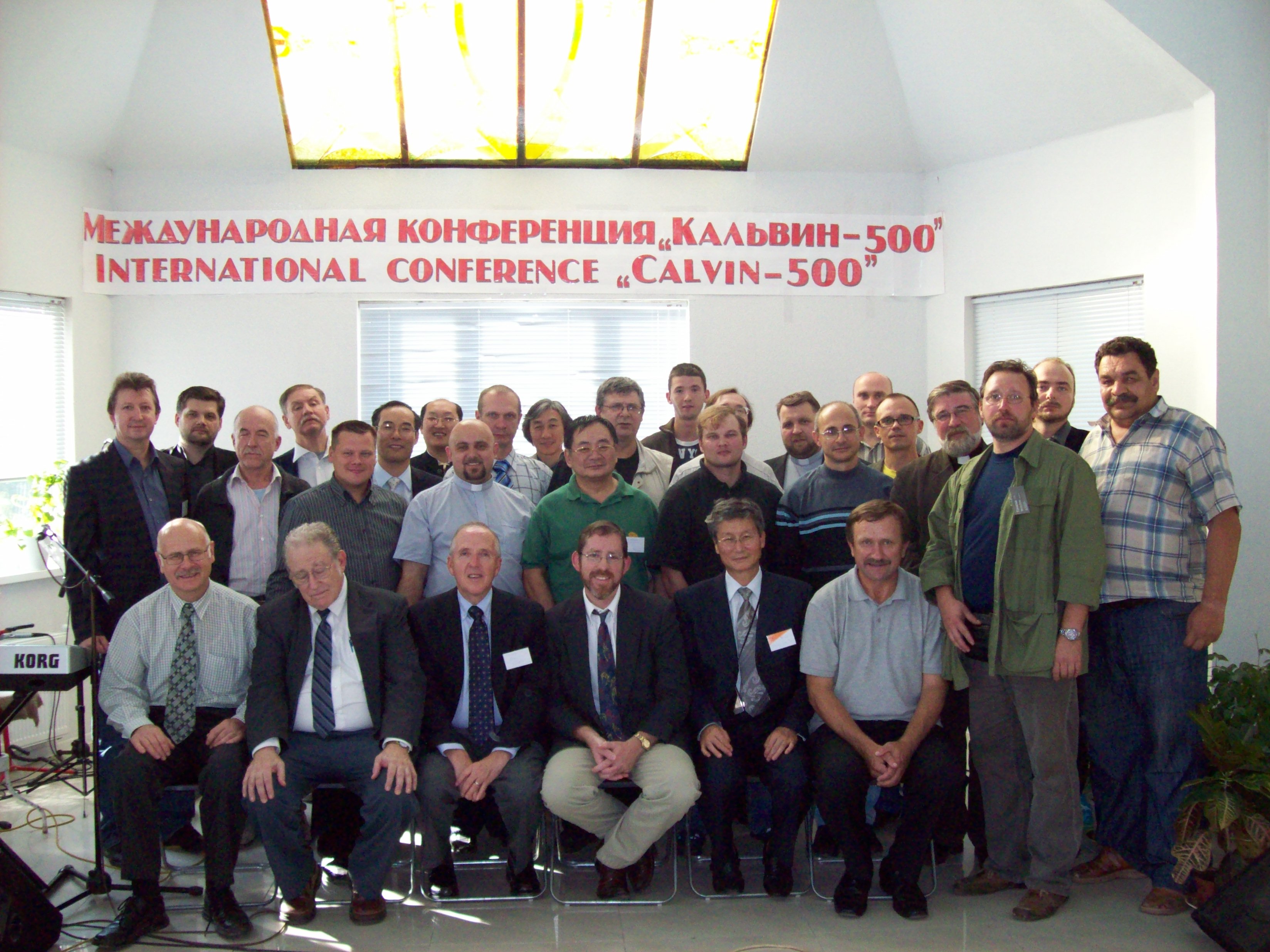

Your Word they have Guarded
“I have made your name known to the people whom you gave me out of this world; they were yours, even so, you gave them and they have guarded your word.”
(John 17:6)
Note the emphasis that is placed here on God’s having given the disciples to Jesus. This, of course, is nothing new to Jesus’ teaching, as he has said:
“No one has the power to come to me unless the Father who sent me draws him; then I will raise him up on the last day.”
(John 6:44)
Yet, while this is not a new teaching for Jesus, in his prayer, Jesus is explicitly driving this point home. Jesus has not made the name of the Father known to all mankind, but only to those whom the Father has drawn to the Son—and those who have been given to the Son have guarded the Word of God. God has elected people to himself from before the foundation of the world (Ephesians 1:3-4) for the purpose of presenting us to the Son and then for the purpose of conforming us into the image of his Son (Romans 8:29) to be presented holy and upright as the bride of our great redeemer (Revelation 19:6-8). From beginning to end, we are not our own, but belong to our mighty and glorious God—praise be to God Almighty, Amen!
Also, note the logical progression of this line of thought. God gave people out of the world to Jesus—it is to them that Jesus has revealed the name of God. Then, the ones whom the Father has given the Son have guarded, or cherished, God’s word. There is a pretty straight forward linear progression that is being reflected in this language—those whom the Father has given have guarded the Word. In turn, those who the Father has not given, have not done so. There does not seem to be any gap between the giving and the guarding—all who have been given will guard—it is a mark of genuine faith that we cherish God’s word and it is a reminder that the fact that we may genuinely cherish God’s word is given to us as a sign of our assurance of salvation.
But what does it mean to cherish or to guard God’s word? The word that Jesus uses here is thre/w(tereo), which reflects the care of one who has been charged to protect something—in our case, to protect the integrity of God’s word in our lives and in the lives of those of our family, church, community, and world. Just like a guard charged with protecting a famous painting from a thief, it is an active job in which we must not fall asleep. We must also protect the integrity of the whole—it does the curator of the Museum if the guard only protects part of the contents, and not the whole—“Sorry sir, they did get away with the painting, but I saved the picture frame it was in!” Somehow, that does not cut it.
Yet, how often Christians pick and choose what they want to protect out of God’s word and what they willfully will cast aside. Christians are often guilty of saying, I like this grace stuff, but you can have that language that calls me to put to death my pet sins. Loved ones, if we are to guard the good deposit entrusted to us, we must guard the whole—and apply it to our lives as ones who cherish it. We must not become lazy or fall off to sleep in our duty, but must stand upon the Word in truth and with boldness, not allowing a jot or tittle—a yod or a serif, as Jesus would have said—to fall away. Such is what it means to guard the Word that God has delivered to us.
Yet, our failure to guard God’s word is a very old failure. As the serpent approached Eve in the garden of God, we find that she and her husband have not been guarding the word that God has given them. She adds to the command of God by saying that she must not touch, and she also takes away from God’s word by decreasing the intensity of the punishment—“You will surely die” (an emphatic statement) simply becomes, “You will die.” And, given that Adam had the responsibility of teaching the command of God to his wife (she had not yet been created when God gave the command), it shows his lack of attention to the Word as well. It is almost as if Adam said to his wife, “Oh, by the way, here is the rule, don’t break it” and then never went back to it.
We may criticize Adam for his failure to teach in this case, but is this not the same trap that we sometimes fall into as parents? We pay lip service to the responsibility we have to teach and train up our children in the faith, yet do we actively pursue doing just that? Our children will learn quickly those things that we are passionate about and they will typically pursue them. They will also learn quickly what things in which you are just going through the motions and will discard them. If statistics tell a story about how we cherish God’s word, then the story it is telling right now is that the majority of church-going Americans are simply going through the motions, and not cherishing what God has entrusted to us.
Loved ones, hear the words of Jesus. Guard the word of God that has been given to you. Love that word and cherish it in your life. Keep it in tact and do not compromise it. Then, instill it into the life of your children in such a way that they will see your own love and zeal for the word that God has sent down. It is said that children can spot a phony a mile away, sometimes I am not so sure about that, but they will quickly realize what it is in your life that you are being phony about. Beloved, be authentic in the guarding of the Word given to you so that your children will learn to guard it themselves and so that the world will know that Jesus Christ is alive in you and be drawn to Him because of that testimony.
 The Preacher's Study